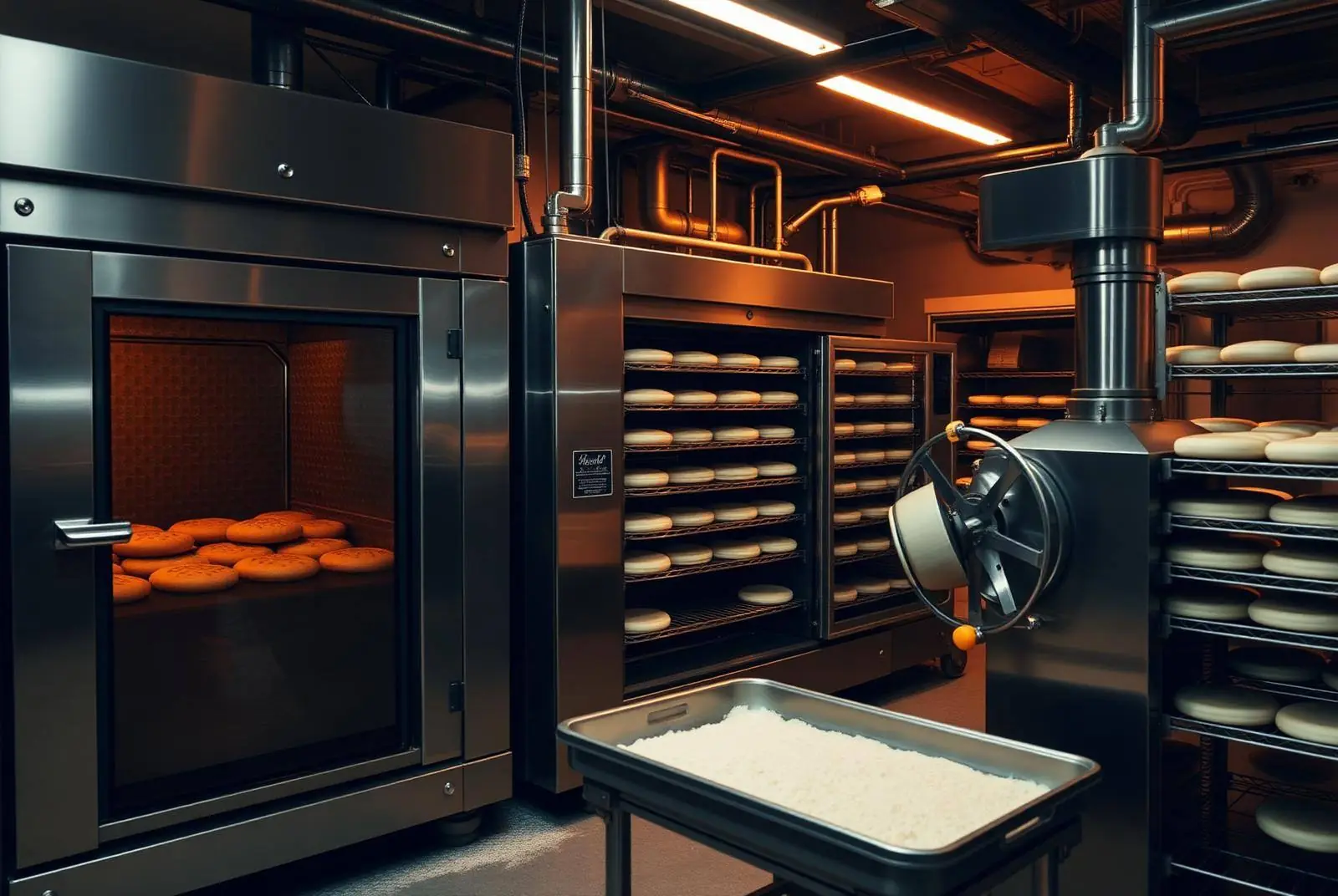
Food machinery · 06
From a single rack oven to a fifty-metre biscuit tunnel.
Bakery equipment is where Indian engineering competes directly with European brands on capability and beats them on price and serviceability. The same fabricators supply neighbourhood bakeries and industrial biscuit plants running three shifts a day.
500 – 12,000 loaves/shift
Output range
Bread · biscuit · cake · rusk
Product families
Rack · deck · tunnel
Oven types
Mixing to sliced, wrapped loaf
Scope
Overview
Fermentation control is what separates bakeries
Anyone can bake bread. Baking the same bread every day, in every season, requires controlled dough temperature, controlled proving humidity and an oven that holds its profile from the first tray to the last.
Mixing sets everything downstream. Spiral mixers with a rotating bowl and two-speed spiral develop gluten with far less friction heat than older planetary designs, and jacketed bowls with chilled water let bakeries in hot climates hold final dough temperature at 24–27 °C — the single most effective quality control a bakery can install. Bowl capacities from 25 kg to 300 kg of flour are standard, with bowl lifters and tippers on larger models.
Dividing and forming determine weight consistency. Volumetric and hydraulic dividers cut dough to ±2–3 g on a 400 g piece; conical rounders form the ball; intermediate provers rest it; and moulders sheet, curl and seam the dough before panning. For pizza, bun and pav production, multi-piece dividers and pressing machines replace the moulder.
Proving happens in a cabinet or room held at 32–38 °C and 80–85% relative humidity with steam injection. Uncontrolled proving is the most common cause of variable loaf volume in tropical bakeries, which is why we quote insulated prover cabinets with humidity control rather than leaving trolleys to prove in the ambient bakery.
Baking splits by scale. Rotary rack ovens bake a full trolley of 16–36 trays with a rotating rack and steam injection, giving even colour with a small footprint — the workhorse for bakeries up to a few thousand loaves per shift. Deck ovens suit artisan crusty products with stone hearths and independent top and bottom heat. Tunnel ovens of 12–60 metres run continuously with three to six independently controlled temperature zones, and are the only practical choice for biscuit and industrial bread plants. Heating can be electric, diesel, LPG, steam-tube or thermic fluid.
Finishing lines complete the plant: spiral or conveyor coolers bringing bread to 32–35 °C core before slicing, reciprocating blade slicers, bread bagging with clip or tape closing, biscuit stacking, sandwiching, cream depositing and wrapping. For rusk and toast, a second-bake tunnel is added after slicing.
At a glance
- Products
- Pan bread, buns, pav, rusk, toast, cookies, hard and soft biscuits, cakes, muffins, pizza base, khari and puff
- Mixers
- Spiral mixers 25–300 kg flour, jacketed bowls, planetary mixers 20–140 litres
- Ovens
- Rotary rack 16–36 trays, deck ovens 2–6 decks, tunnel ovens 12–60 m with 3–6 zones
- Proving
- 32–38 °C at 80–85% RH with steam injection
- Contact material
- SS 304 contact surfaces, aluminised steel baking trays and pans
- Lead time
- 35–50 days for standalone machines; 100–150 days for tunnel-oven plants
How we work
We source from India's established brands — we do not manufacture
Akarta Exports is a sourcing and export house. We do not own factories and we do not claim to. Our value is that we know which well-known Indian brands and manufacturers make what, to what standard, and at what price — and we buy from them to the exact specification you give us.
01 — Your specification, written down
We start from your specification, not from a catalogue. Grade, dimension, tolerance, finish, test standard, pack, artwork and labelling are put in writing and confirmed with you before a single enquiry goes out.
02 — Matched to the right Indian brand
We place that specification with established, well-known Indian brands and manufacturers in the cluster that genuinely makes the product — Morbi for tiles, Rajkot and Ludhiana for machinery, Meerut and Jalandhar for sports goods, Kerala and Gujarat for spices.
03 — Offers compared on merit
Because we own no plant and owe no factory a minimum offtake, we compare offers openly on quality, consistency, capacity and price — and tell you where a lower price will not hold up in your market.
04 — Inspected, consolidated, shipped
Our own inspectors clear the goods at the brand's plant and again before loading. Multiple brands and multiple divisions consolidate into one container, one invoice and one document set.
Brand names are disclosed to you on the offer and named on the inspection report, so you always know whose production you are buying. Where a buyer already has a preferred Indian brand, we are happy to source that brand and handle only the inspection, consolidation, documentation and shipping.
The range
Bakery equipment we supply
A retail bakery takes a mixer, prover and rack oven. An industrial plant takes the full line with continuous tunnel baking and automated packing.
- Mixing & dough handling
- Spiral mixers of 25–300 kg flour with jacketed bowls, bowl lifters and tippers, planetary mixers of 20–140 litres for cake and cream, flour sifters, water dosing and chilling units and dough temperature control.
- Dividing, rounding & moulding
- Volumetric and hydraulic dough dividers at ±2–3 g accuracy, conical rounders, intermediate provers, four-piece and multi-piece bun dividers, bread moulders and pizza dough presses.
- Proving & retarding
- Insulated prover cabinets and rooms with steam humidification at 32–38 °C and 80–85% RH, trolley-loading design, plus retarder-provers for overnight controlled fermentation.
- Rotary rack & deck ovens
- Rotary rack ovens for 16, 18, 24, 32 and 36 trays with steam injection and digital control, and stone-hearth deck ovens of 2–6 decks with independent top and bottom heating, in electric, diesel, LPG or thermic-fluid versions.
- Tunnel ovens
- Continuous tunnel ovens of 12–60 m with wire-mesh or steel band and 3–6 independently controlled zones, direct gas fired, indirect or steam-tube, with band tracking, tension control and exhaust extraction.
- Biscuit lines
- Rotary moulders, cutting machines, wire-cut and depositor machines, dough sheeting lines with gauge rolls, cooling conveyors, stackers, sandwiching machines with cream depositors and on-edge feeders.
- Cooling, slicing & finishing
- Spiral and multi-tier cooling conveyors, reciprocating-blade bread slicers of 8–20 mm pitch, rusk cutting and second-bake tunnels, cake depositors, enrobers and glazing units.
- Packing
- Bread bagging with clip and tape closers, horizontal flow-wrappers for biscuits and cake, tray sealers, multihead weigher and VFFS lines for cookies, metal detectors, date coders and cartoning.
Technical data
Bakery plant specifications by scale
Indicative envelopes for common bakery configurations on a 400 g pan loaf basis or equivalent product weight.
Swipe table to see all columns →
| Plant scale | Output per 8-hour shift | Oven configuration | Connected load | Heating duty | Footprint |
|---|---|---|---|---|---|
| Retail bakery | 500–1,200 loaves | 1 rack oven, 16 trays | 30–45 kW | LPG 6–10 kg/h or electric | 80–150 m² |
| Small industrial | 2,000–3,000 loaves | 2 rack ovens, 24 trays | 60–90 kW | LPG 15–22 kg/h or diesel | 200–350 m² |
| Mid industrial | 5,000–6,000 loaves | Tunnel oven, 18–24 m | 140–200 kW | 500,000–800,000 kcal/h | 400–700 m² |
| Large industrial | 10,000–12,000 loaves | Tunnel oven, 36–48 m | 300–400 kW | 1.2–1.8 million kcal/h | 800–1,200 m² |
| Biscuit line, small | 300–500 kg/h | Tunnel oven, 24–30 m | 120–180 kW | 600,000–900,000 kcal/h | 500–800 m² |
| Biscuit line, large | 800–1,500 kg/h | Tunnel oven, 48–60 m | 280–450 kW | 1.5–2.5 million kcal/h | 1,000–1,600 m² |
| Cake & muffin plant | 500–2,000 kg/shift | Rack or tunnel oven | 60–160 kW | 300,000–800,000 kcal/h | 250–600 m² |
| Rusk & toast plant | 1,000–4,000 kg/shift | Bake plus second-bake tunnel | 100–250 kW | 600,000–1.2 million kcal/h | 400–900 m² |
Final dough temperature is held at 24–27 °C, proving at 32–38 °C and 80–85% RH, and baking at 190–240 °C for pan bread or 160–210 °C across zones for biscuits. Parameters are set per recipe during commissioning.
Applications & markets
Configurations by bakery type
A neighbourhood bakery, a supermarket supplier and a biscuit exporter need very different plants from the same catalogue.
Retail & in-store bakeries
- Compact spiral mixer, prover cabinet and single rack oven
- LPG or electric heating with no boiler requirement
- Manual dividing and moulding with low staffing
- Multi-product flexibility across bread, buns and cookies
Industrial bread plants
- Continuous tunnel oven with multiple controlled zones
- Automatic dividing, moulding and panning at fixed weight
- Spiral cooling before slicing to prevent gumming
- Bagging with clip closing and date coding for retail chains
Biscuit & cookie manufacturers
- Rotary moulder, wire-cut or cutting machine by product type
- Long tunnel ovens with band tracking and zone control
- Sandwiching and cream depositing for premium ranges
- Flow-wrapping and multihead weigher packing lines
Rusk, cake & specialty producers
- Second-bake tunnel for rusk and toast drying
- Planetary mixers and depositors for cake and muffin batter
- Enrobing and glazing units for coated products
- Tray sealing and modified-atmosphere packing for shelf life
Division in numbers
12,000
Loaves per shift
48 metre tunnel oven plant
60
Metre longest tunnel oven
Up to six controlled baking zones
300
kg flour spiral mixer
Jacketed bowl with dough temperature control
±3g
Divider weight accuracy
On a 400 gram dough piece
Quality assurance
Nothing leaves India until our own inspectors clear it
Akarta runs an in-house quality department with inspectors assigned to each division. Goods are checked at the factory during production and again before loading, against the written specification agreed on your purchase order — not against the factory's own grading.
- Pre-production sample approved by the buyer before bulk manufacture begins
- In-line checks during production for shade, calibration, dimension and moisture
- Pre-shipment inspection with photographic report before container sealing
- Third-party inspection (SGS, Bureau Veritas, Intertek) arranged where required
ISO 9001:2015
Certified quality management system
Govt. approved
Registered Indian merchant exporter
In-house docs
Export paperwork prepared by our team
Packing & shipping
Packed the way your market receives it
Ovens are large, insulated and delicate at the corners. Tunnel ovens ship in modules, and module marking is what keeps site assembly on schedule.
- Rack ovens crated whole with doors braced, glass protected and racks shipped separately
- Tunnel ovens shipped in numbered modules with band sections rolled and tagged
- Mixers crated with bowls secured and spiral shafts greased and wrapped
- Trays, pans and moulds nested, strapped and separated by product type
- Burners, blowers and control panels crated with connections blanked and desiccant fitted
- Crate-wise packing list keyed to the bakery layout drawing and module sequence
Documentation
Paperwork prepared in-house, not outsourced
Every consignment travels with a complete document set, prepared by our own documentation team and checked against your letter of credit or contract terms before dispatch.
Bakery layout & flow
Layout drawn to your building with dough room, prover, oven, cooling and packing zones and operator positions marked.
Utility & exhaust schedule
Electrical load, LPG, diesel or steam duty in kcal/h, exhaust duct and chimney sizing, and ventilation air changes.
Recipe & baking parameters
Dough temperature, proving time, humidity, zone-by-zone baking profile and target loaf volume per product.
O&M and food-safety manual
Cleaning schedules, band tracking and tension procedures, burner servicing intervals and complete spare part list.

Global reach
Quoted in your currency, shipped from your nearest Indian port
Enquiries reach us from importers, distributors, contractors and retail chains across five continents — Africa, the Middle East, Europe, the Americas and Asia-Pacific. We quote FOB, CFR or CIF, load from Mundra, Kandla, Nhava Sheva or Pipavav depending on your routing, and keep one commercial contact accountable for the consignment from purchase order to bill of lading.
Africa
Kenya, Tanzania, Uganda, Ethiopia, Nigeria, Ghana, Côte d'Ivoire, Senegal, Egypt, Morocco, Algeria, Sudan, Mozambique, Zambia, South Africa
Middle East
UAE, Saudi Arabia, Qatar, Oman, Kuwait, Bahrain, Jordan, Iraq
Europe
Netherlands, Germany, Spain, Italy, Poland, United Kingdom
Americas
United States, Canada, Mexico, Brazil, Chile
Asia-Pacific
Australia, New Zealand, Singapore, Malaysia, Vietnam, South Korea, Japan
Load ports
Mundra · Kandla · Pipavav · Nhava Sheva
Incoterms
FOB · CFR · CIF · EXW on request
Correspondence
English, with documentation to buyer-country requirements
Buyer questions
What importers usually ask us first
Rack oven or tunnel oven?
Up to about 3,000 loaves per shift, rack ovens are the right answer: lower capital cost, small footprint, and flexible across bread, buns, cookies and cake. Above that, a tunnel oven wins on labour, consistency and fuel per kilogram baked, because product moves continuously through fixed temperature zones instead of being loaded trolley by trolley.
Which fuel should the oven run on?
LPG and diesel are the most common for exported ovens because they need no boiler and are available everywhere. Electric ovens are simplest to control where power is reliable and reasonably priced. Steam-tube and thermic-fluid ovens give the gentlest, most even bake and suit large plants that already run a boiler.
Do we need a prover cabinet?
In any climate that is hot or humid, yes. Uncontrolled proving is why loaf volume varies from morning to afternoon and from season to season. A prover holding 32–38 °C and 80–85% relative humidity is one of the cheapest pieces of equipment in the plant and one of the most visible in the finished product.
Can the same line make bread and biscuits?
Partly. Mixing, cooling and packing equipment overlaps, but forming and baking do not: bread needs dividers, moulders and a humid, high-temperature bake, while biscuits need sheeting or rotary moulding and a long, dry, multi-zone bake. Most plants running both install a rack oven for bread alongside a tunnel oven for biscuits.
What spares should we hold?
Oven band or chain sections, burner nozzles and ignition electrodes, oven door gaskets, mixer bearings and belts, divider knives and seals, and slicer blades. Every plant ships with a two-year fast-wear kit, and consumables like slicer blades and trays are shipped in consolidated repeat orders.
Common enquiries
Specifications buyers most often ask us to quote
These are the enquiries that reach this desk most weeks. If yours is on the list, we already have the grades, packing and loadability worked out — send the quantity and destination port and we will price it.
Also in this division
Related ranges
Export desk
Request a quotation
Send your product type, grade, quantity and destination port. Our export desk replies with available grades, packing options, loadability and indicative pricing — usually within one working day.