Textiles & apparel · Workwear & uniforms
Workwear specified against the standard it has to satisfy.
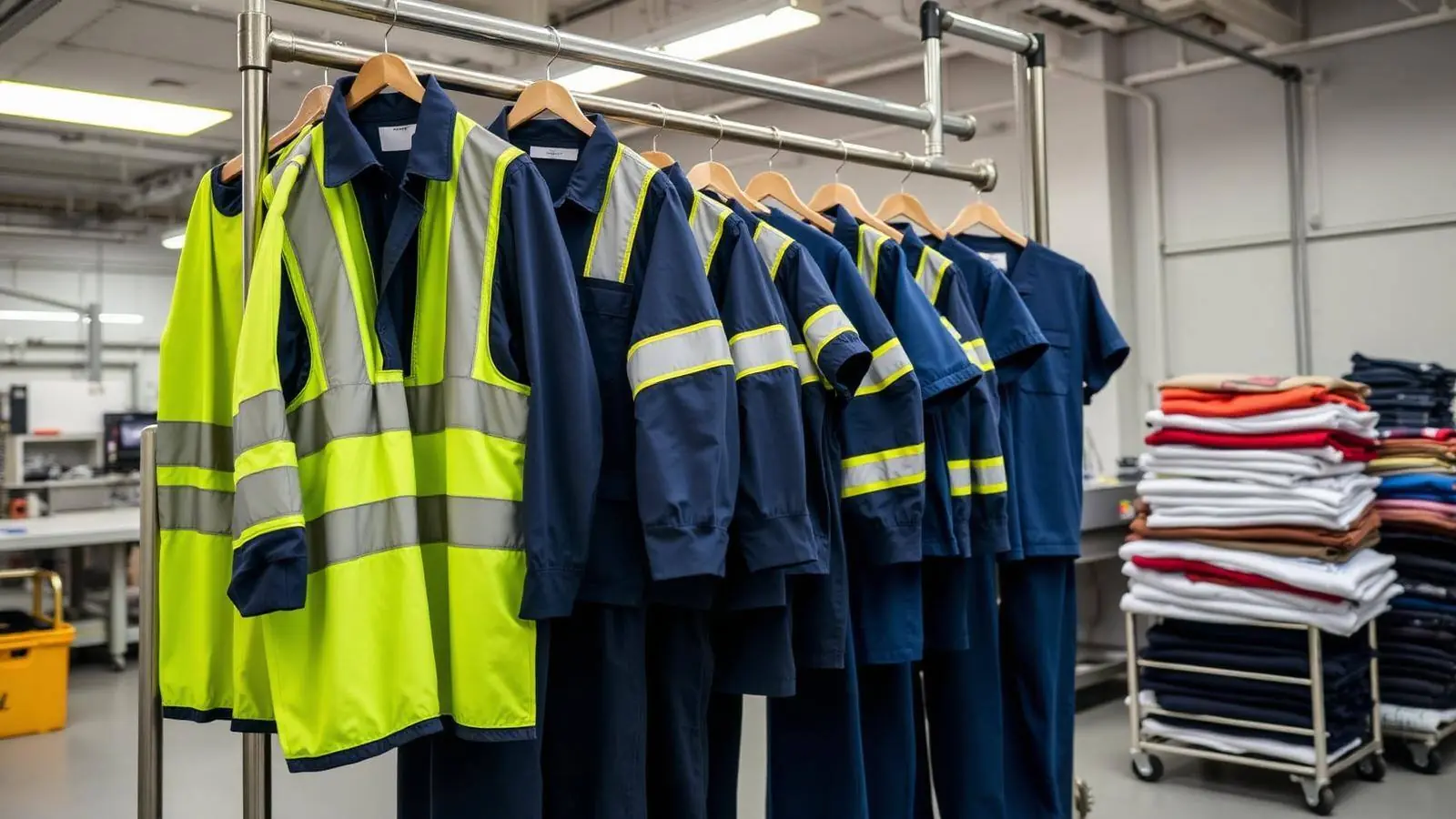
Workwear is bought on standards, not on styling. Hi-vis to EN ISO 20471 needs certified fluorescent fabric and minimum retroreflective areas; FR clothing needs tested fabric, matching thread and compliant trims. We source from units that already produce to those standards, quote the class and certificate on the offer, and never substitute a look-alike fabric to hold a price.
Industrial · hi-vis · FR · medical · hospitality · corporate
Ranges
Delhi NCR · Ahmedabad · Bengaluru · Ludhiana
Clusters
EN ISO 20471 · EN ISO 11612 · EN 1149-5 · EN 13034
Standards
500–1,000 pcs per style per colour
MOQ
Overview
A garment is only as compliant as its fabric, thread and trims
Compliance failures in workwear almost never come from stitching. They come from a fluorescent fabric that was never certified, an FR garment closed with a polyester thread that melts, or reflective tape whose wash performance was never tested. Every component is specified.
High-visibility clothing is defined by measurable areas. EN ISO 20471 Class 1, 2 and 3 each require minimum square metres of fluorescent background and retroreflective material, so a Class 3 jacket cannot be created by adding tape to a Class 1 pattern. We quote the class, the certified fabric, the tape width and configuration, and the number of wash cycles the garment is certified for.
Flame-retardant ranges are built as a system. Inherently FR fabric such as aramid or modacrylic blends, or FR-treated cotton, with FR-compatible thread, metal or FR-rated trims and closures, and testing to EN ISO 11612 for heat and flame, EN ISO 11611 for welding, EN 1149-5 for electrostatic dissipation and IEC 61482 for arc flash where the application requires it.
Chemical, liquid and dust protection ranges cover EN 13034 Type 6 light spray protection and EN ISO 13982 Type 5 particulate protection, in coated, laminated and non-woven constructions, with taped or bound seams where the classification requires them.
Industrial base workwear is bought on fabric weight, seam construction and abrasion resistance. Poly-cotton 65/35 and 80/20 twill in 190–320 GSM, cotton drill and canvas, with felled seams, bar-tacked stress points, double-stitched crotch and seat, triple-needle knee panels, reinforced pockets and hardware rated for daily use and industrial laundering.
Medical, hospitality and corporate uniforms have a different priority: repeated high-temperature laundering, colour retention and presentation. Scrubs, lab coats, patient gowns, chef jackets and trousers, housekeeping and F&B uniforms, security wear and corporate shirting are specified with wash-cycle-rated fastness and shrinkage rather than one-wash figures.
Branding and identification are part of the build: chest and back logo embroidery, name badges and tapes, department colour coding, heat-transfer and printed logos rated for industrial wash, epaulettes, ID card holders and reflective personalisation.
At a glance
- Industrial
- Coveralls, boiler suits, bib overalls, two-piece work suits, cargo and multi-pocket trousers, work shirts, jackets, dungarees
- High visibility
- Vests, waistcoats, T-shirts, polos, jackets, bomber and parka, trousers, rainwear, traffic and railway ranges to Class 1–3
- Protective
- FR coveralls and suits, welding jackets and aprons, anti-static wear, chemical spray suits, cleanroom garments
- Medical
- Scrub tops and trousers, scrub sets, lab coats, patient gowns, theatre caps, isolation and visitor gowns
- Hospitality & corporate
- Chef jackets, trousers and aprons, housekeeping and F&B uniforms, security wear, corporate shirting, blazers, school uniforms
- Standards
- EN ISO 20471, EN ISO 11612, EN ISO 11611, EN 1149-5, EN 13034, EN ISO 13688, ANSI/ISEA 107
How we work
We source from India's established brands — we do not manufacture
Akarta Exports is a sourcing and export house. We do not own factories and we do not claim to. Our value is that we know which well-known Indian brands and manufacturers make what, to what standard, and at what price — and we buy from them to the exact specification you give us.
01 — Your specification, written down
We start from your specification, not from a catalogue. Grade, dimension, tolerance, finish, test standard, pack, artwork and labelling are put in writing and confirmed with you before a single enquiry goes out.
02 — Matched to the right Indian brand
We place that specification with established, well-known Indian brands and manufacturers in the cluster that genuinely makes the product — Morbi for tiles, Rajkot and Ludhiana for machinery, Meerut and Jalandhar for sports goods, Kerala and Gujarat for spices.
03 — Offers compared on merit
Because we own no plant and owe no factory a minimum offtake, we compare offers openly on quality, consistency, capacity and price — and tell you where a lower price will not hold up in your market.
04 — Inspected, consolidated, shipped
Our own inspectors clear the goods at the brand's plant and again before loading. Multiple brands and multiple divisions consolidate into one container, one invoice and one document set.
Brand names are disclosed to you on the offer and named on the inspection report, so you always know whose production you are buying. Where a buyer already has a preferred Indian brand, we are happy to source that brand and handle only the inspection, consolidation, documentation and shipping.
The range
The workwear programme in detail
- Industrial coveralls & work suits
- Single-piece coveralls and boiler suits with concealed brass or nylon zip and storm flap, bib-and-brace overalls, two-piece jacket and trouser suits, cargo and multi-pocket work trousers, knee-pad-pocket trousers, work shirts, drill jackets, bodywarmers and dungarees in poly-cotton 65/35 and 80/20 twill 190–320 GSM or cotton drill, with felled seams, bar tacks and reinforced knees and seat.
- High-visibility clothing
- Class 1, 2 and 3 garments in fluorescent yellow, orange-red and red — sleeveless vests and waistcoats, executive and railway vests, hi-vis t-shirts and polos, softshell and bomber jackets, parkas, three-in-one jackets, hi-vis coveralls, trousers, over-trousers and rain suits — built with certified fluorescent fabric and 50 mm retroreflective tape in two-band, brace or H configuration to EN ISO 20471 and ANSI/ISEA 107.
- Flame-retardant & arc protection
- FR coveralls, two-piece suits, jackets, trousers and shirts in inherently FR modacrylic and aramid blends or FR-treated cotton, welding jackets, sleeves, aprons and spats in leather and FR cotton, anti-static garments to EN 1149-5, and arc-flash rated clothing to IEC 61482 with FR thread, FR interlining and metal or FR-rated closures throughout.
- Chemical, dust & cleanroom
- EN 13034 Type 6 light-spray coveralls, EN ISO 13982 Type 5 particulate coveralls, non-woven and laminated disposable coveralls, chemical aprons, sleeve protectors, hoods, cleanroom coveralls, smocks and shoe covers, with bound or taped seams as the classification requires.
- Medical & healthcare
- V-neck and mock-wrap scrub tops, drawstring and elastic scrub trousers, scrub sets in poly-cotton and poly-viscose 150–200 GSM, lab coats in 3/4 and full length, consultation coats, patient gowns, theatre gowns and caps, isolation and visitor gowns, dental jackets and colour-coded departmental ranges rated for repeated high-temperature laundering.
- Hospitality, corporate & school
- Chef jackets in single- and double-breasted styles, chef trousers, skull caps and neckerchiefs, bib and waist aprons in cotton, canvas and denim, housekeeping tunics, F&B waistcoats and shirts, valet and porter uniforms, security shirts and trousers, corporate shirting and blazers, plus complete school uniform programmes with crest embroidery and house colours.
Technical data
Standards, fabrics and constructions we quote against
Indicative specification set for the ranges we ship most often. Certificates are issued against the fabric lot and garment style used on your order.
Swipe table to see all columns →
| Range | Standard | Fabric | GSM | Key construction | Wash cycles |
|---|---|---|---|---|---|
| Hi-vis vest | EN ISO 20471 Class 2 | Fluorescent poly knit / tricot | 120–140 | 50 mm tape, two horizontal bands | 25 at 60 °C |
| Hi-vis jacket | EN ISO 20471 Class 3 | Fluorescent poly oxford, PU coated | 200–240 | Tape bands plus braces, taped seams | 25 at 60 °C |
| Industrial coverall | EN ISO 13688 | PC 65/35 twill | 245–260 | Felled seams, bar tacks, storm flap | 50 industrial |
| Heavy work trouser | EN ISO 13688 | Cotton drill / canvas | 280–320 | Triple-needle knee, reinforced seat | 50 industrial |
| FR coverall (treated) | EN ISO 11612 A1 B1 C1 | FR-treated cotton | 260–300 | FR thread, brass zip, FR tape | 50 at 60 °C |
| FR coverall (inherent) | EN ISO 11612 · EN 1149-5 | Modacrylic-cotton-antistatic | 230–260 | FR thread, FR trims, taped label | 100 at 60 °C |
| Welding jacket | EN ISO 11611 Class 2 | FR cotton / split leather | 400–500 | Kevlar-type thread, snap closure | Per care label |
| Type 6 spray coverall | EN 13034 | PP-PE laminate / coated PC | 60–120 | Bound seams, elastic cuffs and hood | Limited / single use |
| Scrub set | Institutional laundry | PC 65/35 or poly-viscose | 150–180 | Overlock plus coverstitch, side vents | 75 at 71 °C |
| Chef jacket | Food-service standard | PC 65/35 twill | 190–210 | Press-stud or knot buttons, thermometer pocket | 75 at 71 °C |
Hi-vis and FR certification applies to a specific fabric lot and garment configuration. Any change of fabric supplier, tape or trim voids the certificate, so we lock all three for the life of a programme and reissue documentation if a change becomes unavoidable.
Applications & markets
Sectors we supply
Construction & infrastructure
- Class 2 and 3 hi-vis to site access requirements
- Heavy drill trousers with knee-pad pockets
- Coveralls rated for industrial laundering
- Site-wide colour coding by trade or contractor
- Contractor logo embroidery and back printing
- Multi-year colour and spec continuity
Oil, gas, power & utilities
- Inherent FR with anti-static to EN 1149-5
- Arc-flash rated garments to IEC 61482
- Welding jackets, aprons and sleeves
- Full certification and test-report file per lot
- Sized programmes with named-person tapes
- Traceable batch numbering per garment
Healthcare & laboratories
- Scrub sets in departmental colour codes
- Lab coats and consultation coats
- Patient, isolation and theatre gowns
- High-temperature laundry-rated fastness
- Bulk unbranded packing for laundry intake
- Tender documentation and compliance sheets
Hospitality, retail & institutions
- Chef and F&B uniform programmes
- Housekeeping and front-of-house ranges
- Corporate shirting with logo placement
- Security and facilities-management wear
- School uniform programmes with crests
- Size-ratio packing by property or branch
Division in numbers
Class 1–3
Hi-vis coverage
EN ISO 20471 certified fabric
190–320
Workwear GSM
Poly-cotton twill to cotton canvas
50–100
Certified wash cycles
Treated and inherent FR ranges
65–90
Days to load
Standard to certified FR programmes
Quality assurance
Nothing leaves India until our own inspectors clear it
Akarta runs an in-house quality department with inspectors assigned to each division. Goods are checked at the factory during production and again before loading, against the written specification agreed on your purchase order — not against the factory's own grading.
- Pre-production sample approved by the buyer before bulk manufacture begins
- In-line checks during production for shade, calibration, dimension and moisture
- Pre-shipment inspection with photographic report before container sealing
- Third-party inspection (SGS, Bureau Veritas, Intertek) arranged where required
ISO 9001:2015
Certified quality management system
Govt. approved
Registered Indian merchant exporter
In-house docs
Export paperwork prepared by our team
Packing & shipping
Packed the way your market receives it
Workwear usually goes into a store, a laundry or a site issue desk rather than onto a shelf, so packing is built around how the garments will be distributed and counted.
- Individual polybags with size sticker, barcode and care label including wash-cycle limits
- Size-wise and colour-wise solid packing for issue-desk and laundry intake
- Named-person or department-tagged packing for corporate programmes
- Sets packed together where a jacket and trouser are issued as a pair
- Bulk bale packing for institutional and laundry-fed contracts
- Five-ply cartons with style, size, colour and batch marking
- Certification and test-report file packed with the shipment and emailed in advance
- Carton-wise packing list with size breakdown and cube before dispatch
Documentation
Paperwork prepared in-house, not outsourced
Every consignment travels with a complete document set, prepared by our own documentation team and checked against your letter of credit or contract terms before dispatch.
Technical pack
Fabric specification and GSM, standard and class claimed, tape configuration, thread and trim specification, graded measurement chart and logo placement drawing.
Certification file
EN ISO 20471, EN ISO 11612, EN ISO 11611, EN 1149-5, EN 13034 or ANSI/ISEA test reports and certificates for the fabric lot and garment configuration, plus declared wash-cycle performance and care labelling.
Inspection report
Fabric inspection before cutting, in-line reports at 20% and 60% of production, tape placement and area verification on hi-vis, and AQL 2.5 final random inspection with photographed defect classification.
Shipping set
Commercial invoice, carton-wise packing list with cube, certificate of origin, bill of lading and insurance certificate where CIF.

Global reach
Quoted in your currency, shipped from your nearest Indian port
Enquiries reach us from importers, distributors, contractors and retail chains across five continents — Africa, the Middle East, Europe, the Americas and Asia-Pacific. We quote FOB, CFR or CIF, load from Mundra, Kandla, Nhava Sheva or Pipavav depending on your routing, and keep one commercial contact accountable for the consignment from purchase order to bill of lading.
Africa
Kenya, Tanzania, Uganda, Ethiopia, Nigeria, Ghana, Côte d'Ivoire, Senegal, Egypt, Morocco, Algeria, Sudan, Mozambique, Zambia, South Africa
Middle East
UAE, Saudi Arabia, Qatar, Oman, Kuwait, Bahrain, Jordan, Iraq
Europe
Netherlands, Germany, Spain, Italy, Poland, United Kingdom
Americas
United States, Canada, Mexico, Brazil, Chile
Asia-Pacific
Australia, New Zealand, Singapore, Malaysia, Vietnam, South Korea, Japan
Load ports
Mundra · Kandla · Pipavav · Nhava Sheva
Incoterms
FOB · CFR · CIF · EXW on request
Correspondence
English, with documentation to buyer-country requirements
Buyer questions
What importers usually ask us first
What is the difference between hi-vis Class 1, 2 and 3?
The classes are defined by minimum areas of fluorescent background and retroreflective material. Class 1 is the lowest coverage and suits low-risk off-road use, Class 2 typically covers a vest or waistcoat with two bands, and Class 3 requires sleeve coverage — which in practice means a jacket or a coverall, not a vest. If a supplier offers a Class 3 vest, the claim is wrong.
Is treated FR fabric as good as inherent FR?
For many applications yes, and it is considerably cheaper. FR-treated cotton normally certifies for around 50 industrial washes, after which the treatment degrades. Inherent FR — modacrylic and aramid blends — keeps its protection for the life of the garment and typically certifies to 100 washes or more. We quote both with the certified wash count stated so the decision is made on total cost per wear rather than on unit price.
Can you supply garments with our certification requirements and our logo?
Yes. Logo embroidery, heat-transfer and print are applied in positions that do not compromise the certified reflective or FR areas — placement is agreed on a drawing before sampling, because a badge sewn over a reflective band invalidates the class. Name tapes, department codes and ID holders are all handled at the unit.
Do you handle industrial-laundry-rated uniforms?
Yes, and it is a different specification from retail workwear. Industrial laundering means high-temperature wash, harsh chemistry and tunnel finishing, so we specify fabrics and trims rated for it, use shrinkage figures measured after industrial cycles rather than domestic ones, and choose closures and labels that survive the process.
What is your minimum order for uniform programmes?
Typically 500 to 1,000 pieces per style per colour, spread across the size curve. Certified hi-vis and FR ranges sit at the higher end because the certified fabric has its own minimum roll quantity. Programmes below that are possible on standard colours where stock fabric exists, and we say so on the offer.
Can multiple uniform categories ship together?
Yes. Industrial workwear, hi-vis, scrubs and hospitality ranges can come from different units and load into a single container with one packing list and one document set, with each style's certification file included in the shipment.
Common enquiries
Specifications buyers most often ask us to quote
These are the enquiries that reach this desk most weeks. If yours is on the list, we already have the grades, packing and loadability worked out — send the quantity and destination port and we will price it.
Also in this division
Related ranges
Export desk
Request a quotation
Send your product type, grade, quantity and destination port. Our export desk replies with available grades, packing options, loadability and indicative pricing — usually within one working day.