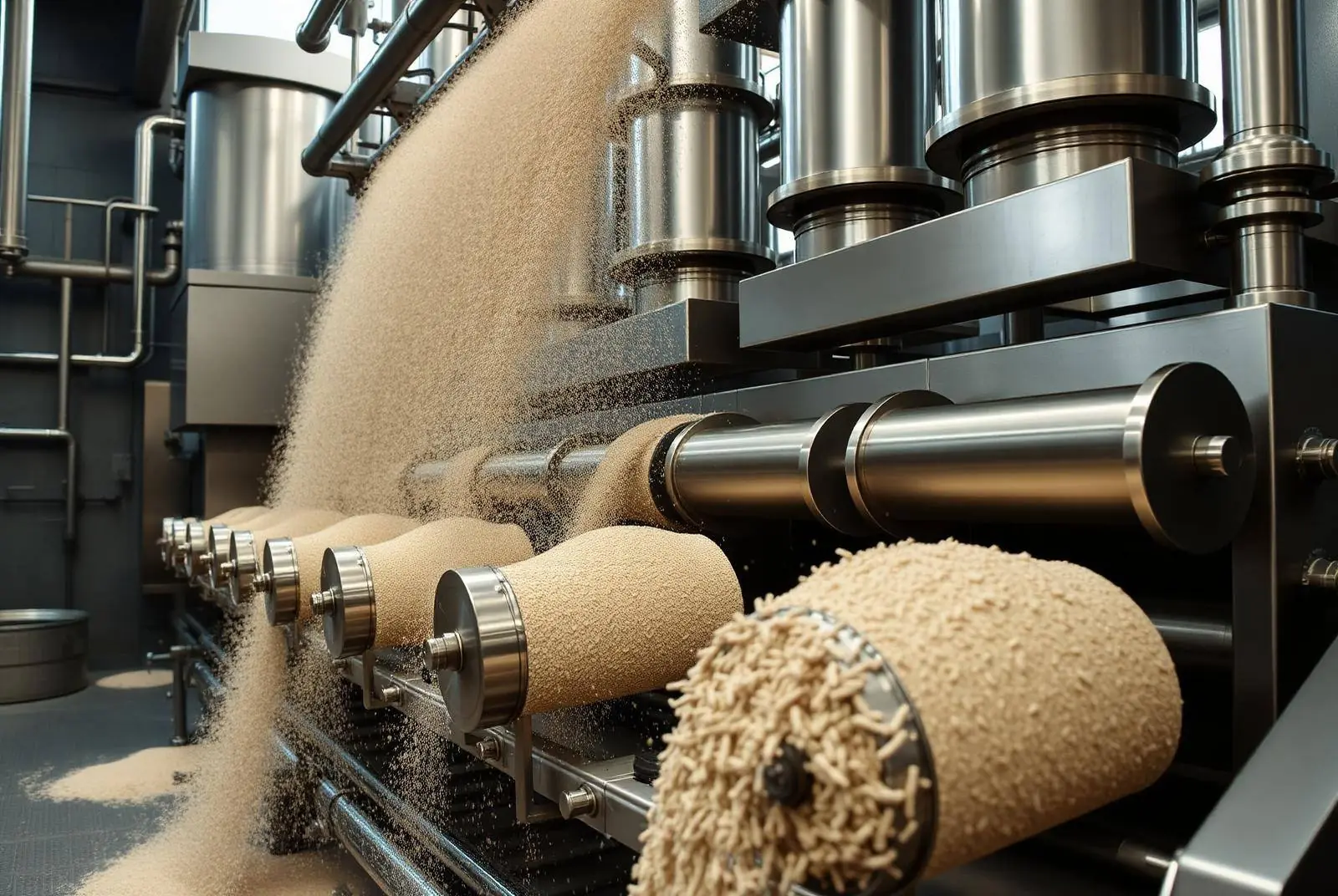
Food machinery · 01
Wheat in at one end, bagged flour out at the other.
Flour milling is the largest food-machinery export line India has, and the range is unusually wide: a single-machine atta chakki for a village market, or a five-floor roller flour mill producing 300 tonnes of maida, sooji, atta and bran every day. We quote both from the same engineering desk.
200 kg/h – 300 TPD
Capacity range
Wheat · maize · millet · pulses
Grains handled
72 – 78% maida (roller mills)
Extraction rate
Cleaning to bagging, turnkey
Scope
Overview
Two entirely different machines called by one name
An atta chakki grinds whole wheat in a single pass and sells on simplicity and low power. A roller flour mill separates the grain into endosperm, semolina and bran across dozens of passages and sells on extraction rate and flour specification. Choosing wrongly is the most expensive mistake a new miller makes.
Atta chakki plants use emery-stone or steel-disc grinding at 900–1,500 rpm, with an aspiration channel to keep flour temperature down and a rotary or vibro sifter to grade the output. They run at roughly 0.06–0.09 kWh per kilogram of flour, need one or two semi-skilled operators, and are the correct choice for wholemeal atta markets in Africa, South Asia and the Middle East where the consumer expects the bran to stay in the flour.
Roller flour mills break the wheat progressively between chilled cast-iron rolls — corrugated break rolls followed by smooth reduction rolls — with purifiers and plansifters between passages. Milling is preceded by a full cleaning house and by conditioning: wheat is dampened to 15.5–16.5% moisture and rested 8–24 hours in tempering bins so the bran peels cleanly. This is what makes 72–78% maida extraction with 0.45–0.55% ash possible.
Cleaning is where most flour quality is won. A standard cleaning house runs a drum or vibro pre-cleaner, a magnetic separator to protect the rolls, an aspiration channel, a gravity destoner, an indented cylinder or disc separator for barley and oats, a scourer or peeler, and increasingly an optical sorter for ergot and dark impurities. We size each unit at 1.5–2× the mill's nominal throughput so cleaning never becomes the bottleneck.
Product handling is quoted to suit your building. Small plants use bucket elevators and gravity spouting; from about 30 TPD upwards we specify low-pressure pneumatic conveying, which costs more in power but keeps the mill dust-controlled and reduces the number of floors required. Bagging can be manual with a scale and stitcher, semi-automatic with a net weigher, or fully automatic with a packing machine at 300–600 bags per hour.
At a glance
- Typical grains
- Wheat, maize, sorghum, millet, gram, besan and spice-grade grinding
- Roll material
- Chilled cast-iron rolls, 250 × 600 / 250 × 1,000 mm, 25 flutes/inch range
- Conditioning
- Dampening to 15.5–16.5% moisture, 8–24 h tempering
- Specific energy
- Atta chakki 0.06–0.09 kWh/kg; roller mill 0.055–0.075 kWh/kg
- Products
- Atta, maida, sooji/semolina, rava, bran, germ, animal-feed fraction
- Lead time
- 35–50 days for chakki plants; 100–150 days for roller mills
How we work
We source from India's established brands — we do not manufacture
Akarta Exports is a sourcing and export house. We do not own factories and we do not claim to. Our value is that we know which well-known Indian brands and manufacturers make what, to what standard, and at what price — and we buy from them to the exact specification you give us.
01 — Your specification, written down
We start from your specification, not from a catalogue. Grade, dimension, tolerance, finish, test standard, pack, artwork and labelling are put in writing and confirmed with you before a single enquiry goes out.
02 — Matched to the right Indian brand
We place that specification with established, well-known Indian brands and manufacturers in the cluster that genuinely makes the product — Morbi for tiles, Rajkot and Ludhiana for machinery, Meerut and Jalandhar for sports goods, Kerala and Gujarat for spices.
03 — Offers compared on merit
Because we own no plant and owe no factory a minimum offtake, we compare offers openly on quality, consistency, capacity and price — and tell you where a lower price will not hold up in your market.
04 — Inspected, consolidated, shipped
Our own inspectors clear the goods at the brand's plant and again before loading. Multiple brands and multiple divisions consolidate into one container, one invoice and one document set.
Brand names are disclosed to you on the offer and named on the inspection report, so you always know whose production you are buying. Where a buyer already has a preferred Indian brand, we are happy to source that brand and handle only the inspection, consolidation, documentation and shipping.
The range
Flour milling equipment we supply
Machine-by-machine, this is the scope a flour mill quotation covers. Small plants use a subset; a full roller mill uses all of it.
- Grain cleaning house
- Vibro or drum pre-cleaner, permanent and electromagnetic separators, aspiration channel, gravity destoner (10–120 TPH models), indented cylinder separator, horizontal and vertical scourers, and optical colour sorter for high-value flour.
- Conditioning & tempering
- Water dosing dampener with flow meter and intensive dampener, plus tempering bins sized for 8–24 hours of rest at mill throughput. Includes moisture meter for incoming and conditioned wheat.
- Roller stands (break & reduction)
- Four-roller and eight-roller stands with chilled cast-iron rolls, pneumatic or mechanical roll engagement, feed gate with feed roll and independent drive per pair, typically 4–6 break passages and 8–12 reduction passages on a modern mill.
- Plansifters & purifiers
- Free-swinging square plansifters with 4, 6 or 8 sections and nylon or stainless sieve stacks, plus double-deck purifiers with air aspiration for semolina and sooji grading.
- Atta chakki & pulverisers
- Emery-stone chakkis (12″–36″ stone) and steel-disc mills from 200 kg/h to 2 TPH, with hopper feeder, magnetic protection, aspiration cyclone, rotary sifter and flour cooling conveyor.
- Pneumatic & mechanical conveying
- Low-pressure pneumatic lifts with high-pressure blowers, cyclones and airlocks; bucket elevators, screw conveyors, chain conveyors and gravity spouting in food-grade finish for smaller plants.
- Dust control & flour finishing
- Jet-pulse bag filters, centrifugal fans, rebolt sifters, entoleters and flour blending or fortification dosing units for iron, folic acid and vitamin premixes.
- Bagging & palletising
- Net and gross weighers, auger or impeller packers for 1–50 kg packs, bag stitchers, check weighers, metal detectors and semi-automatic palletising for 25 kg and 50 kg sacks.
Technical data
Flour mill plant specifications by capacity
Indicative engineering envelopes. Extraction rate assumes sound milling wheat at 11–13% protein; softer or damaged wheat reduces both extraction and throughput.
Swipe table to see all columns →
| Plant size | Throughput | Roller stands | Connected load | Floors / footprint | Operators per shift |
|---|---|---|---|---|---|
| Atta chakki, single unit | 200–500 kg/h | Not applicable (stone mill) | 7.5–22 kW | 1 floor / 40–80 m² | 1–2 |
| Atta plant, mini | 1–2 TPH | Not applicable (disc/stone) | 30–60 kW | 1–2 floors / 150–250 m² | 2–3 |
| Roller flour mill | 30 TPD | 3 stands (6 break, 8 reduction) | 150–200 kW | 3 floors / 400–600 m² | 3–4 |
| Roller flour mill | 50 TPD | 4 stands | 220–280 kW | 3–4 floors / 600–850 m² | 4–5 |
| Roller flour mill | 100 TPD | 6 stands | 400–500 kW | 4 floors / 1,000–1,400 m² | 5–6 |
| Roller flour mill | 200 TPD | 10 stands | 800–1,000 kW | 5 floors / 1,600–2,000 m² | 6–8 |
| Roller flour mill | 300 TPD | 14 stands | 1,150–1,400 kW | 5 floors / 2,000–2,500 m² | 8–10 |
Flour specification typically achieved: maida 0.45–0.55% ash, moisture 13.5–14%, wet gluten 26–32%; sooji 0.60–0.75% ash; atta 1.20–1.60% ash. Values confirmed against your wheat on trial milling.
Applications & markets
Markets these plants serve
The same equipment list is configured very differently depending on the market the flour is sold into.
Wholemeal atta millers
- Stone or disc chakki for warm-ground wholemeal texture
- Low connected load, single-phase options up to 15 kW
- 1, 5 and 10 kg retail packing with auger filler
- Simple maintenance: stone dressing rather than roll fluting
Bakery-grade maida producers
- Full cleaning house plus conditioning for high extraction
- Purifiers for sooji and semolina by-product revenue
- Ash and gluten testing lab equipment quoted alongside
- Fortification dosing to national premix regulations
Maize & millet processors
- Degerminator and maize grits milling configuration
- Roller stands re-fluted for maize meal and grits sizing
- Millet, sorghum and teff milling for African markets
- Bran and germ recovery for animal-feed sale
Institutional & relief supply
- Tender-compliant datasheets and performance guarantees
- 50 kg jute or PP sack bagging lines with stitching
- Diesel-generator-suitable starters for unstable grids
- Third-party pre-shipment inspection on request
Division in numbers
300
TPD largest plant
Five-floor roller flour mill
78%
Peak maida extraction
On sound conditioned milling wheat
14
Roller stands maximum
Six break and twelve reduction passages
100–150
Days for turnkey mills
Fabrication, trial run and shipment
Quality assurance
Nothing leaves India until our own inspectors clear it
Akarta runs an in-house quality department with inspectors assigned to each division. Goods are checked at the factory during production and again before loading, against the written specification agreed on your purchase order — not against the factory's own grading.
- Pre-production sample approved by the buyer before bulk manufacture begins
- In-line checks during production for shade, calibration, dimension and moisture
- Pre-shipment inspection with photographic report before container sealing
- Third-party inspection (SGS, Bureau Veritas, Intertek) arranged where required
ISO 9001:2015
Certified quality management system
Govt. approved
Registered Indian merchant exporter
In-house docs
Export paperwork prepared by our team
Packing & shipping
Packed the way your market receives it
A roller flour mill can fill six to twelve containers. Marking, crate lists and lashing plans are what keep an erection schedule from collapsing at site.
- Roller stands crated individually with rolls locked and journals VCI-wrapped
- Plansifters shipped with sieve stacks removed, numbered and boxed separately
- Pneumatic pipework bundled by line number with matched bends and clamps
- Control panels crated upright with desiccant and shock-absorbing packing
- Crate-wise packing list cross-referenced to the plant layout drawing
- Flat rack or open top arranged for over-dimensional cyclones and bins
Documentation
Paperwork prepared in-house, not outsourced
Every consignment travels with a complete document set, prepared by our own documentation team and checked against your letter of credit or contract terms before dispatch.
Plant layout & floor loading
Multi-floor layout drawn to your building, with floor loading in kN/m² and equipment anchor positions.
Milling diagram
Passage-by-passage flow sheet showing break and reduction sequence, sieve sizes and product streams.
Electrical load schedule
Motor list with kW, full-load current, starter type and total connected load for your incoming supply.
O&M and roll-fluting manual
Maintenance intervals, roll fluting and dressing specification, sieve replacement schedule and spare part numbers.

Global reach
Quoted in your currency, shipped from your nearest Indian port
Enquiries reach us from importers, distributors, contractors and retail chains across five continents — Africa, the Middle East, Europe, the Americas and Asia-Pacific. We quote FOB, CFR or CIF, load from Mundra, Kandla, Nhava Sheva or Pipavav depending on your routing, and keep one commercial contact accountable for the consignment from purchase order to bill of lading.
Africa
Kenya, Tanzania, Uganda, Ethiopia, Nigeria, Ghana, Côte d'Ivoire, Senegal, Egypt, Morocco, Algeria, Sudan, Mozambique, Zambia, South Africa
Middle East
UAE, Saudi Arabia, Qatar, Oman, Kuwait, Bahrain, Jordan, Iraq
Europe
Netherlands, Germany, Spain, Italy, Poland, United Kingdom
Americas
United States, Canada, Mexico, Brazil, Chile
Asia-Pacific
Australia, New Zealand, Singapore, Malaysia, Vietnam, South Korea, Japan
Load ports
Mundra · Kandla · Pipavav · Nhava Sheva
Incoterms
FOB · CFR · CIF · EXW on request
Correspondence
English, with documentation to buyer-country requirements
Buyer questions
What importers usually ask us first
Should we buy an atta chakki plant or a roller flour mill?
It depends entirely on the flour you sell. If your market wants wholemeal atta, a chakki plant costs a fraction as much, uses less power per tonne and needs less skill to run. If you need white maida, sooji or bakery-specification flour with controlled ash, only a roller mill will produce it — the separation simply cannot be done by single-pass grinding.
How much wheat do we need in store to run the mill?
Plan on a minimum of ten to fifteen days of milling capacity in silos or godown, plus tempering bins for 8–24 hours of conditioned wheat. A 100 TPD mill therefore needs roughly 1,000–1,500 tonnes of raw wheat storage and about 60–100 tonnes of tempering capacity.
Can the mill handle maize, millet or pulses as well as wheat?
Yes, with configuration changes. Maize needs a degerminator ahead of milling and a different roll fluting; pulses and besan are usually better served by a dedicated disc mill or pulveriser. Tell us the full product list at enquiry stage and we design the flow for the switch-over rather than retrofitting later.
What is the realistic power consumption?
A well-set roller flour mill consumes about 0.055–0.075 kWh per kilogram of flour including cleaning and conveying. An atta chakki plant runs a little higher per kilogram at 0.06–0.09 kWh, but on a much smaller connected load. We give the connected load and the estimated running load on every quotation so you can size your transformer and generator.
How long does installation take at site?
A mini atta plant is running within a week of the crates opening. A 30–50 TPD roller mill takes three to five weeks of erection followed by one week of trial milling and adjustment; a 200–300 TPD plant takes eight to twelve weeks. Civil work and building readiness, not machinery, is usually the critical path.
Common enquiries
Specifications buyers most often ask us to quote
These are the enquiries that reach this desk most weeks. If yours is on the list, we already have the grades, packing and loadability worked out — send the quantity and destination port and we will price it.
Also in this division
Related ranges
Export desk
Request a quotation
Send your product type, grade, quantity and destination port. Our export desk replies with available grades, packing options, loadability and indicative pricing — usually within one working day.