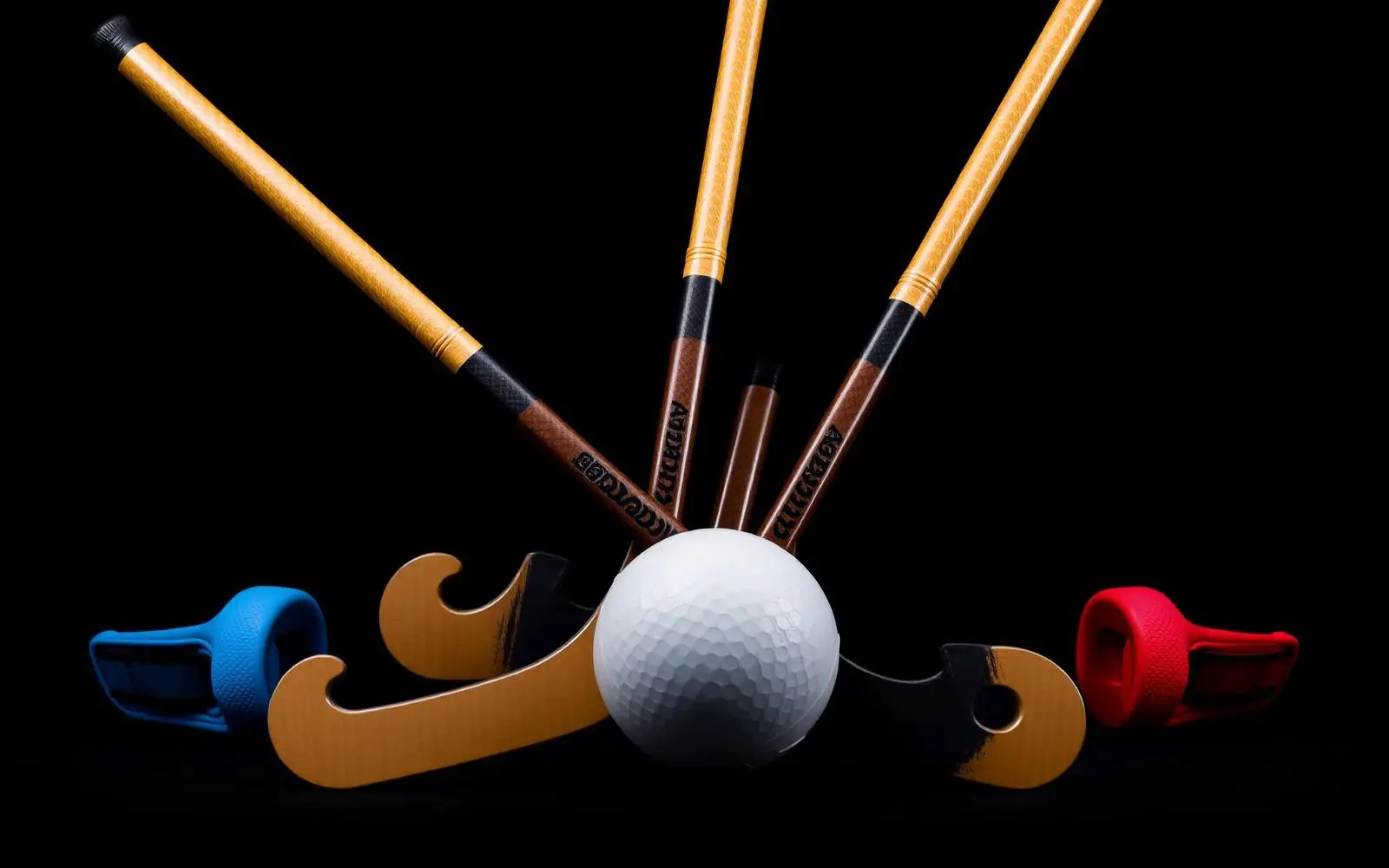
Sports goods · 03
India has made hockey sticks longer than it has made anything else in sport.
Eight Olympic golds were won with sticks turned in Punjab. The wood is now mostly composite and the bow shapes have changed three times in twenty years, but the manufacturing knowledge — how much carbon, where, and at what cure temperature — has stayed in the same few towns.
20% to 95% carbon
Composite range
28" to 37.5"
Stick lengths
Standard · low · mid · extra low
Bow types
Jalandhar, Punjab
Cluster
Overview
Carbon percentage, bow position and toe shape define a stick
Three numbers describe almost any modern hockey stick: how much carbon is in the laminate, where the bow peaks along the shaft, and how much rake is left at the toe. Get those three right for your market's playing level and the rest is graphics.
Composite sticks are laid up from carbon fibre, aramid and fibreglass over a foam or wood core, then cured under pressure in a mould. Carbon content drives stiffness and power transfer: 20–30% suits juniors and beginners who need forgiveness, 50–70% suits club and school play, and 90–95% is for elite players who can generate their own power and want the hardest possible hit. Aramid is added at the head and shaft for vibration damping and impact resistance.
Bow shape changes how the stick behaves on the ball. A standard bow with a 20–22 mm rise peaking mid-shaft is the safe all-round choice. Low bow and extra-low bow sticks — with the peak moved toward the head and up to the regulation 25 mm maximum deflection — make aerial lifts, drag flicks and 3D skills dramatically easier, and are what advanced attacking players ask for. Regulations cap total deflection at 25 mm, and we source only from brands that build to that limit rather than past it.
Toe shape follows position. Shorti toes suit midfielders wanting quick stickwork, hook and midi toes give more receiving surface for general play, and maxi toes give defenders and goalkeepers the largest blocking area. Head reinforcement with aramid or a rubberised edge extends life on abrasive water-based and sand-dressed turf.
Wooden sticks have not disappeared. Mulberry and ash sticks with fibreglass or carbon wrapping remain the right answer for school programmes, indoor play and price-sensitive markets: they are cheaper, repairable, and gentler on young hands. Indoor sticks are lighter with a thinner head profile suited to a smoother surface and a lighter ball.
Goalkeeping is a complete sub-range and the most technical part of hockey supply: leg guards, kickers, hand protectors, body armour, chest and pelvic protection, throat guards, helmets with cages, and goalkeeper sticks with reinforced heads. Sizing is by player height and shoe size, and every item needs its own size grid on the purchase order.
Balls are simpler but still specified: dimpled balls for grass and sand-dressed turf where the dimples channel water and grit, smooth balls for water-based turf where speed matters, plus practice, training and indoor variants. Match balls run 156–163 g at 224–235 mm circumference, matching cricket-ball dimensions closely but with a very different core.
At a glance
- Composite construction
- Carbon, aramid and fibreglass over foam or wood core
- Max deflection
- 25 mm bow under FIH rules
- Stick weight
- 530–620 g senior, 400–520 g junior
- Match ball
- 156–163 g, 224–235 mm circumference
- Turf types served
- Water-based, sand-dressed, hybrid, grass, indoor
- Lead time
- 40–55 days for composite sticks with custom graphics
How we work
We source from India's established brands — we do not manufacture
Akarta Exports is a sourcing and export house. We do not own factories and we do not claim to. Our value is that we know which well-known Indian brands and manufacturers make what, to what standard, and at what price — and we buy from them to the exact specification you give us.
01 — Your specification, written down
We start from your specification, not from a catalogue. Grade, dimension, tolerance, finish, test standard, pack, artwork and labelling are put in writing and confirmed with you before a single enquiry goes out.
02 — Matched to the right Indian brand
We place that specification with established, well-known Indian brands and manufacturers in the cluster that genuinely makes the product — Morbi for tiles, Rajkot and Ludhiana for machinery, Meerut and Jalandhar for sports goods, Kerala and Gujarat for spices.
03 — Offers compared on merit
Because we own no plant and owe no factory a minimum offtake, we compare offers openly on quality, consistency, capacity and price — and tell you where a lower price will not hold up in your market.
04 — Inspected, consolidated, shipped
Our own inspectors clear the goods at the brand's plant and again before loading. Multiple brands and multiple divisions consolidate into one container, one invoice and one document set.
Brand names are disclosed to you on the offer and named on the inspection report, so you always know whose production you are buying. Where a buyer already has a preferred Indian brand, we are happy to source that brand and handle only the inspection, consolidation, documentation and shipping.
The range
Every field hockey item we export
The full programme, from a 95% carbon senior stick to a school set of wooden sticks and a bag of practice balls.
- Composite sticks — elite
- 90%, 92% and 95% carbon sticks with aramid reinforcement, extra-low and low bow profiles at 24–25 mm deflection, shorti, hook, midi and maxi toe options, 36.5" and 37.5" lengths, matte and gloss finishes, PU and rubberised grip options, drag-flick specific and penalty-corner sticks.
- Composite sticks — club & school
- 20%, 30%, 40%, 50%, 60% and 70% carbon sticks in standard, mid and low bow, 28" to 37.5" lengths, junior and youth weights from 400 g, fibreglass-dominant beginner sticks, reinforced-head training sticks, colour-matched school-set sticks in team quantities.
- Wooden sticks
- Mulberry and ash sticks with fibreglass or carbon wrapping, laminated wooden sticks, indoor wooden sticks with slim head profiles, junior wooden sticks from 28", practice and street-hockey sticks, mini and souvenir sticks, repairable school-grade sticks.
- Goalkeeper sticks
- Reinforced-head goalkeeper sticks in composite and wood, maxi and extra-maxi toe profiles for maximum blocking area, shorter 34"–36.5" lengths, impact-damped shafts, aramid-wrapped heads for repeated foot and ball contact.
- Balls
- Dimple match balls for sand-dressed and grass turf, smooth match balls for water-based turf, practice and training balls, coloured and hi-vis balls, indoor balls, ball bags and mesh sacks of 6, 12 and 60, penalty-corner and shooting practice balls.
- Field player protection
- Shin guards with and without ankle protection, slip-in and strap-on shin pads, ankle guards, hand and knuckle protectors for corner defence, mouth guards in single and double layer, gum shields with cases, protective face masks for penalty corners, glove and mitt options for grip in wet play.
- Goalkeeper equipment
- Leg guards in foam and composite, kickers with rigid and flexible soles, right and left hand protectors, clamshell and blocker glove designs, body armour and chest protectors, abdominal and pelvic guards, arm and elbow pads, throat protectors, neck guards, groin protection, goalkeeper helmets with steel cages, goalkeeper smocks and full kit sets sized by player height.
- Goals, nets & field
- Full-size and junior hockey goals, goal nets in 2–4 mm knotted polypropylene, goal backboards and side boards, corner flags, sideline boards, penalty-corner rebound boards, portable and indoor goals, net anchors, dugout benches and pitch marking equipment.
- Training equipment
- Rebound and passing boards, drag-flick trainers, agility poles and slalom sticks, marker cones and discs, agility ladders and hurdles, dribbling gates, ball feeders and hoppers, training bibs, tactic boards, speed and resistance training aids.
- Bags & carry
- Single and double stick bags, wheeled stick bags, backpack stick bags with shoe compartments, goalkeeper kit bags, team gear bags, ball bags and hoppers, boot bags, holdalls with wet compartments.
- Grips & accessories
- Chamois and towel grips, PU and cushion over-grips, spiral and octopus grip designs, grip tape and edge tape, anti-scuff head tape, stick wax and stick bows, ball-marking chalk, umpire cards and whistles, scoreboard and match record sets.
Technical data
Hockey stick and ball specifications
What we quote and inspect against. Bow deflection, weight and length are measured on samples drawn from each production batch.
Swipe table to see all columns →
| Item | Grade | Length | Weight | Bow / profile | Construction |
|---|---|---|---|---|---|
| Stick, elite | 95% carbon | 36.5" / 37.5" | 540–580 g | Extra low, 24–25 mm | Carbon with aramid head, foam core |
| Stick, advanced | 90% carbon | 36.5" / 37.5" | 550–600 g | Low, 23–25 mm | Carbon-aramid laminate |
| Stick, club | 60–70% carbon | 35" / 36.5" | 560–610 g | Mid or low, 22–24 mm | Carbon-fibreglass laminate |
| Stick, school | 30–50% carbon | 34" / 35" / 36.5" | 570–620 g | Standard, 20–22 mm | Fibreglass-dominant laminate |
| Stick, junior | 20–30% carbon | 28" – 33" | 400–520 g | Standard, 19–21 mm | Fibreglass over wood core |
| Stick, wooden | Mulberry / ash | 28" – 36.5" | 520–620 g | Standard, 18–21 mm | Fibreglass or carbon wrapped |
| Stick, goalkeeper | Composite / wood | 34" – 36.5" | 560–640 g | Standard, maxi toe | Reinforced aramid head |
| Ball, match dimple | Match | — | 156–163 g | 224–235 mm circumference | Plastic shell, cork or resin core |
| Ball, match smooth | Match | — | 156–163 g | 224–235 mm circumference | Seamless smooth shell |
| Shin guard | Club / match | S–XL | 180–320 g pair | Ankle-integrated optional | EVA and HDPE shell |
| GK leg guards | Club / match | Small–XL | 1.8–3.2 kg pair | By player height | Foam or composite core |
| GK kickers | Club / match | Shoe 4–13 | 0.9–1.6 kg pair | Rigid or flexible sole | Composite shell, strap fit |
Sticks are built to FIH dimensional rules: maximum 25 mm bow deflection, passing through a 51 mm ring, with no sharp edges and a flat playing side only. Sticks intended for competition use can be routed through FIH-approved production where the mark is required.
Applications & markets
Ranges by turf and playing level
A water-based turf club and a school playing on grass need different sticks, different balls and different protection. These are the four configurations we quote most.
Water-based turf, elite
- 90–95% carbon sticks in low and extra-low bow
- Smooth match balls for maximum surface speed
- Shorti and hook toes for fast close stickwork
- Full goalkeeper kit with composite leg guards
- Penalty-corner face masks and hand protectors
- Individual player stick specification sheets
Sand-dressed & hybrid turf, club
- 50–70% carbon sticks in mid and low bow
- Dimple balls to shed grit and standing water
- Reinforced heads for abrasive surface wear
- Midi and maxi toes for reliable receiving
- Shin guards with integrated ankle protection
- Volume-priced team sets in club colourways
Grass & school programmes
- Wooden and 20–40% carbon sticks in 28" to 36.5"
- Dimple practice balls in bulk mesh sacks
- Junior weights from 400 g for young players
- Repairable, forgiving construction for shared use
- Class-set packs with mixed size grids
- Goals, nets, cones and bibs in the same container
Indoor hockey
- Lighter sticks with slim head profiles
- Indoor balls with controlled bounce
- Lower-carbon sticks for touch over power
- Hall-safe goals and rebound boards
- Compact goalkeeper protection for close play
- Non-marking accessory and grip options
Division in numbers
95%
Maximum carbon
Elite composite laminate
25 mm
Bow limit
Built to FIH rule, not past it
28"–37.5"
Length range
Junior through senior
9,000
Sticks per 40' HC
Bundled and head-protected
Quality assurance
Nothing leaves India until our own inspectors clear it
Akarta runs an in-house quality department with inspectors assigned to each division. Goods are checked at the factory during production and again before loading, against the written specification agreed on your purchase order — not against the factory's own grading.
- Pre-production sample approved by the buyer before bulk manufacture begins
- In-line checks during production for shade, calibration, dimension and moisture
- Pre-shipment inspection with photographic report before container sealing
- Third-party inspection (SGS, Bureau Veritas, Intertek) arranged where required
ISO 9001:2015
Certified quality management system
Govt. approved
Registered Indian merchant exporter
In-house docs
Export paperwork prepared by our team
Packing & shipping
Packed the way your market receives it
A hockey stick is long, thin and expensive, and it flexes. Everything about hockey packing is about preventing flex damage and head abrasion in transit.
- Sticks individually sleeved with head protection and packed head-to-tail in bundles of 10
- Composite sticks bubble-wrapped and cross-strapped in long five-ply cartons
- Balls boxed in retail sixes or bulk mesh sacks of 12 and 60
- Goalkeeper kit boxed by size set with left and right items paired and labelled
- Shin guards and gloves poly-bagged in pairs with size labels
- Goals and posts bundled with tube ends capped and fittings bagged separately
- Nets bagged and tagged with mesh size, twine gauge and dimension
- Carton-wise packing list keyed to length, carbon grade, bow and toe shape
Documentation
Paperwork prepared in-house, not outsourced
Every consignment travels with a complete document set, prepared by our own documentation team and checked against your letter of credit or contract terms before dispatch.
Stick specification sheet
Carbon percentage, laminate schedule, bow type and deflection, toe shape, length, weight band, grip and finish, with an approved sample photograph.
Ball & compliance data
Weight, circumference, hardness and rebound per batch; FIH approval certificates where competition marking is required.
Protective sizing grid
Size-by-size measurements for shin guards, gloves and full goalkeeper kit against player height and shoe size.
Inspection & shipping set
AQL 2.5 pre-shipment report with measured deflection and weights, invoice, packing list, certificate of origin and bill of lading.

Global reach
Quoted in your currency, shipped from your nearest Indian port
Enquiries reach us from importers, distributors, contractors and retail chains across five continents — Africa, the Middle East, Europe, the Americas and Asia-Pacific. We quote FOB, CFR or CIF, load from Mundra, Kandla, Nhava Sheva or Pipavav depending on your routing, and keep one commercial contact accountable for the consignment from purchase order to bill of lading.
Africa
Kenya, Tanzania, Uganda, Ethiopia, Nigeria, Ghana, Côte d'Ivoire, Senegal, Egypt, Morocco, Algeria, Sudan, Mozambique, Zambia, South Africa
Middle East
UAE, Saudi Arabia, Qatar, Oman, Kuwait, Bahrain, Jordan, Iraq
Europe
Netherlands, Germany, Spain, Italy, Poland, United Kingdom
Americas
United States, Canada, Mexico, Brazil, Chile
Asia-Pacific
Australia, New Zealand, Singapore, Malaysia, Vietnam, South Korea, Japan
Load ports
Mundra · Kandla · Pipavav · Nhava Sheva
Incoterms
FOB · CFR · CIF · EXW on request
Correspondence
English, with documentation to buyer-country requirements
Buyer questions
What importers usually ask us first
What carbon percentage should we stock?
For a general retail or club range, 30% to 70% covers most sales. Below 30% is a beginner and junior product; above 90% is a small-volume elite line that sells on prestige as much as performance. A common range structure is 20% junior, 40% and 60% club, and one 90% flagship, which covers every price point without proliferating stock.
Why does bow shape matter so much?
Bow position determines how easily a player can get under the ball. A low or extra-low bow makes drag flicks, aerials and 3D skills far easier, which is why advanced players want it. It also makes clean, low ground passing slightly harder, so it is the wrong recommendation for beginners. All our sticks respect the 25 mm deflection limit; sticks bowed past it are not legal for match play.
Dimple or smooth balls?
Dimple for sand-dressed turf and grass, where the dimples move water and grit out of the contact patch and keep the ball predictable. Smooth for water-based turf, where the surface is already fast and even. If you supply mixed clubs, dimple balls are the safer default because they play acceptably on every surface.
Do you supply complete goalkeeper kits?
Yes, as sized sets: leg guards, kickers, hand protectors, body armour, abdominal and pelvic guards, throat protector, helmet and smock. Sizing runs off player height and shoe size, so we ask for a size grid with the order. Kits ship as one boxed set per size so the club does not have to reconcile loose items at intake.
Are the sticks FIH approved?
All sticks are built to FIH dimensional rules — deflection, ring gauge, flat playing side and edge geometry. Where the FIH mark itself is required for sanctioned competition, we route production through an approved facility and supply the certification with the shipment. For school, club and retail supply the mark is generally not required.
How long does a composite stick last?
On water-based turf, a season to two seasons of regular play. On sand-dressed and abrasive surfaces, head wear is the limiting factor, which is why we specify aramid-wrapped or rubberised-edge heads for those markets and supply anti-scuff head tape as a consumable. Wooden school sticks are repairable and often last several years under lighter use.
Common enquiries
Specifications buyers most often ask us to quote
These are the enquiries that reach this desk most weeks. If yours is on the list, we already have the grades, packing and loadability worked out — send the quantity and destination port and we will price it.
Also in this division
Related ranges
Export desk
Request a quotation
Send your product type, grade, quantity and destination port. Our export desk replies with available grades, packing options, loadability and indicative pricing — usually within one working day.