Food machinery · 05
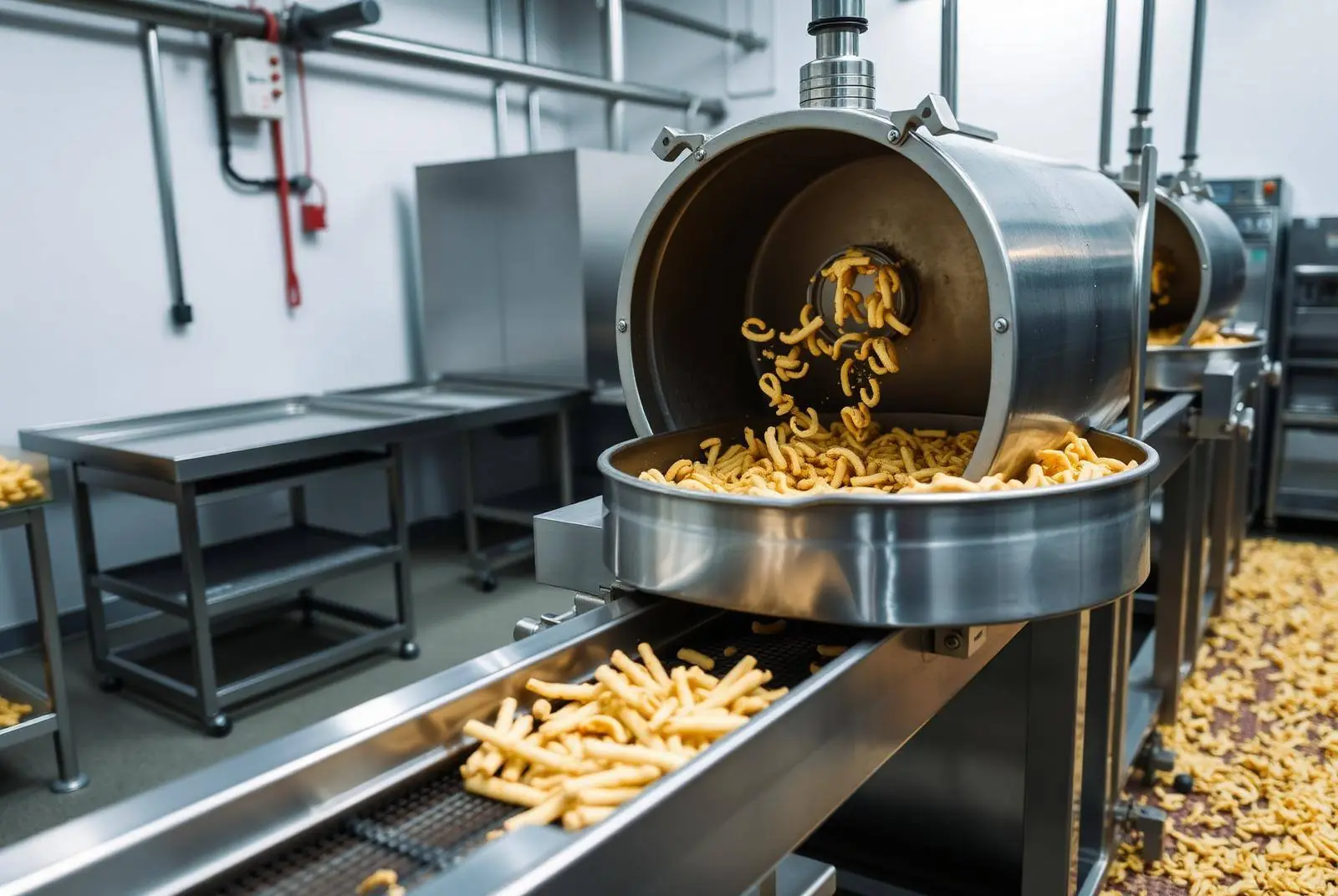
Fried, extruded, seasoned and sealed in one continuous pass.
India's snack industry runs on machinery built for hot oil, abrasive seasoning powders and long shifts. The same equipment that supplies a namkeen plant in Gujarat now runs potato chips, extruded puffs and coated nuts across Africa, the Gulf and South-East Asia.
100 – 1,000 kg/h finished
Capacity range
Fried · extruded · coated · baked
Product families
150 – 190 °C controlled
Frying temperature
Raw prep to sealed pack
Scope
Overview
Oil management is the whole business
A snack line's economics are decided by how well it treats its frying oil. Continuous filtration, tight temperature control and a properly sized oil turnover keep free fatty acids low, shelf life long and oil cost per kilogram of product predictable.
Continuous fryers move product through a hot-oil bath on a submerged mesh conveyor with a paddle or hold-down belt, oil heated indirectly by a thermic-fluid or steam heat exchanger, or directly by an LPG or diesel burner. Indirect heating is preferred for anything premium: the oil never sees flame temperature, so it degrades far more slowly. Oil is circulated continuously through a filter and back to the fryer, and oil turnover — the ratio of oil in the system to oil consumed per hour — is designed at 8–12 hours to keep quality stable.
After frying, a de-oiling centrifuge or vibratory de-oiler removes surface oil, cutting finished fat content by 3–8 percentage points, which matters both for nutrition labelling and for shelf life. Product then passes to a seasoning system: a rotating drum with a volumetric or loss-in-weight powder feeder, and for oil-sprayed seasoning, a nozzle bar synchronised to product flow so coating is even rather than clumped.
Extrusion is the other half of the industry. Single-screw extruders make simple corn puffs and pellets cheaply; twin-screw extruders control temperature, pressure and shear precisely enough to make filled pillows, textured protein snacks, breakfast cereal and fortified blended foods. Extruders are followed by a rotary or belt dryer to bring moisture to 2–4%, a cooling conveyor, then seasoning and packing.
Traditional namkeen equipment remains a large part of what we export: sev and bhujia extruders with hydraulic rams and interchangeable dies, gathiya machines, dough kneaders, potato peelers, slicers with adjustable blade thickness, blanchers, and batch fryers with hand-operated hoists. Many plants combine traditional batch equipment for regional lines with a continuous line for volume products.
At a glance
- Products
- Potato chips, banana chips, namkeen, bhujia, sev, extruded puffs, pellets, coated nuts, roasted grams
- Frying
- Batch 25–100 kg and continuous 100–1,000 kg/h, thermic fluid, steam, LPG or diesel
- Oil filtration
- Continuous inline filtration with 8–12 hour oil turnover design
- Finished moisture
- 1.5–3% for fried snacks; 2–4% for extruded
- Contact material
- SS 304 throughout; fryer body in SS 304 with insulated jacket
- Lead time
- 40–60 days for single machines; 100–140 days for turnkey lines
How we work
We source from India's established brands — we do not manufacture
Akarta Exports is a sourcing and export house. We do not own factories and we do not claim to. Our value is that we know which well-known Indian brands and manufacturers make what, to what standard, and at what price — and we buy from them to the exact specification you give us.
01 — Your specification, written down
We start from your specification, not from a catalogue. Grade, dimension, tolerance, finish, test standard, pack, artwork and labelling are put in writing and confirmed with you before a single enquiry goes out.
02 — Matched to the right Indian brand
We place that specification with established, well-known Indian brands and manufacturers in the cluster that genuinely makes the product — Morbi for tiles, Rajkot and Ludhiana for machinery, Meerut and Jalandhar for sports goods, Kerala and Gujarat for spices.
03 — Offers compared on merit
Because we own no plant and owe no factory a minimum offtake, we compare offers openly on quality, consistency, capacity and price — and tell you where a lower price will not hold up in your market.
04 — Inspected, consolidated, shipped
Our own inspectors clear the goods at the brand's plant and again before loading. Multiple brands and multiple divisions consolidate into one container, one invoice and one document set.
Brand names are disclosed to you on the offer and named on the inspection report, so you always know whose production you are buying. Where a buyer already has a preferred Indian brand, we are happy to source that brand and handle only the inspection, consolidation, documentation and shipping.
The range
Snack processing equipment we supply
Lines are assembled from these building blocks and configured to your product mix, shift pattern and building.
- Raw material preparation
- Potato and vegetable washers, abrasive and knife peelers, slicers with adjustable 1.0–2.5 mm blades, dicers, blanchers, hydro-extractors, dough kneaders and flour dosing hoppers.
- Batch fryers
- Round and rectangular batch fryers of 25–100 kg per batch, in SS 304 with insulated walls, LPG, diesel, wood or thermic-fluid heating, hoisted baskets and integrated oil drain and filter.
- Continuous fryers
- Submerged-conveyor continuous fryers of 100–1,000 kg/h with indirect thermic-fluid or steam heating, hold-down belt, oil circulation pump, inline filter, fines removal auger and PID temperature control.
- De-oiling & cooling
- Basket and continuous centrifugal de-oilers, vibratory de-oiling conveyors and multi-zone cooling conveyors with ambient or chilled air to bring product to packing temperature.
- Extruders
- Single-screw extruders of 100–500 kg/h and twin-screw extruders of 150–1,000 kg/h with barrel temperature zones, die-face cutters, pellet dies, fortified-blend and textured-protein configurations.
- Seasoning systems
- Rotating seasoning drums of 100–1,000 kg/h with volumetric or loss-in-weight powder feeders, oil spray nozzle bars, slurry seasoning applicators and drum flight design matched to product fragility.
- Namkeen & traditional lines
- Sev and bhujia extruders with hydraulic rams and die sets, gathiya machines, papad and roti machines, chana and peanut roasters, coating pans and jaggery-coated snack equipment.
- Weighing & packing
- Multihead weighers of 10–14 heads at 40–120 packs per minute, vertical form-fill-seal machines, nitrogen flushing, pillow and gusset pouch formats, check weighers, metal detectors and cartoning.
Technical data
Line specifications by capacity
Indicative envelopes for continuous lines. Batch operations and traditional namkeen equipment scale differently and are quoted per machine.
Swipe table to see all columns →
| Line type | Output | Connected load | Heating duty | Oil in system | Footprint |
|---|---|---|---|---|---|
| Batch namkeen unit | 100–200 kg/h | 15–35 kW | LPG 8–15 kg/h | 150–400 litres | 80–150 m² |
| Continuous fryer line | 150 kg/h | 35–50 kW | 150,000–250,000 kcal/h | 600–900 litres | 150–250 m² |
| Continuous fryer line | 300 kg/h | 60–90 kW | 300,000–450,000 kcal/h | 1,200–1,800 litres | 250–400 m² |
| Continuous fryer line | 600 kg/h | 110–160 kW | 600,000–900,000 kcal/h | 2,500–3,500 litres | 400–700 m² |
| Potato chips line | 300–500 kg/h | 90–140 kW | 400,000–700,000 kcal/h | 1,500–2,500 litres | 400–800 m² |
| Single-screw extrusion line | 150–300 kg/h | 45–80 kW | Electric barrel heating | Not applicable | 200–350 m² |
| Twin-screw extrusion line | 300–1,000 kg/h | 120–300 kW | Electric or steam preconditioning | Not applicable | 350–800 m² |
| Packing hall (weigher + VFFS) | 40–120 packs/min | 15–40 kW | Compressed air 250–600 lpm | Not applicable | 100–250 m² |
Fried snack finished moisture is typically held at 1.5–3% and fat content at 22–34% depending on product and de-oiling. Frying oil FFA is kept below 1% by continuous filtration and designed oil turnover.
Applications & markets
Line configurations by product
Fragile products need gentle handling; abrasive seasonings need wear-resistant contact parts. Every line is configured to the product mix you actually plan to run.
Potato & banana chips producers
- Washer, peeler and precision slicer with blade thickness control
- Blanching and hydro-extraction to control colour and oil pickup
- Continuous frying with indirect heating for pale, even colour
- Gentle seasoning drum and nitrogen-flushed pillow packs
Namkeen & bhujia manufacturers
- Sev and bhujia extruders with interchangeable die sets
- Batch fryers for regional recipes alongside continuous lines
- Mixing and blending of multi-component namkeen mixes
- 25 kg bulk plus 20–200 g retail pouch packing
Extruded snack & cereal plants
- Twin-screw extrusion for filled pillows and textured shapes
- Pellet production for third-party frying and distribution
- Fortified blended food lines for institutional supply
- Coating and enrobing for sweet and chocolate cereals
Nut, gram & pulse roasters
- Continuous rotary and batch roasters with LPG or electric heat
- Salting, coating and jaggery-glazing equipment
- De-skinning and colour sorting for peanut and cashew lines
- Vacuum and nitrogen packing to extend oxidative shelf life
Division in numbers
1,000
kg/h maximum output
Continuous fryer and twin-screw lines
120
Packs per minute
Multihead weigher with VFFS
8–12
Hour oil turnover design
Keeps frying oil FFA below 1%
8
Points fat reduction
Continuous centrifugal de-oiling
Quality assurance
Nothing leaves India until our own inspectors clear it
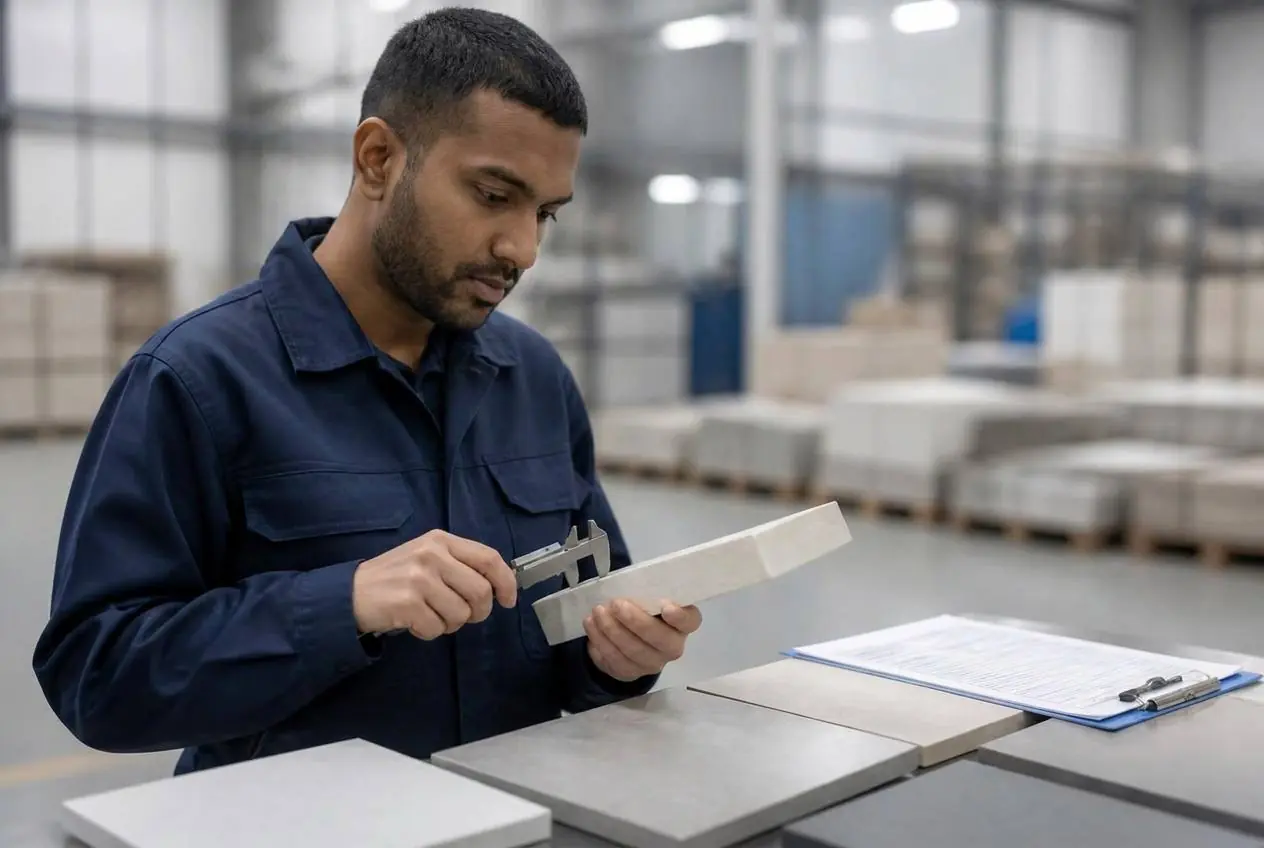
Akarta runs an in-house quality department with inspectors assigned to each division. Goods are checked at the factory during production and again before loading, against the written specification agreed on your purchase order — not against the factory's own grading.
- Pre-production sample approved by the buyer before bulk manufacture begins
- In-line checks during production for shade, calibration, dimension and moisture
- Pre-shipment inspection with photographic report before container sealing
- Third-party inspection (SGS, Bureau Veritas, Intertek) arranged where required
ISO 9001:2015
Certified quality management system
Govt. approved
Registered Indian merchant exporter
In-house docs
Export paperwork prepared by our team
Packing & shipping
Packed the way your market receives it
Fryers and conveyors are large, thin-walled and easily deformed. Crating protects geometry, because a twisted fryer conveyor never tracks properly again.
- Fryer bodies crated with internal bracing to prevent shell distortion in transit
- Conveyor belts shipped rolled, wrapped and tagged to the machine they belong to
- Extruder barrels and screws greased, VCI-wrapped and boxed with die sets labelled
- Weighers and VFFS machines crated as sealed units with load cells locked for transport
- Thermic-fluid heaters and burners crated with connections blanked and gaskets boxed
- Crate-wise packing list keyed to the line layout and machine tag numbers
Documentation
Paperwork prepared in-house, not outsourced
Every consignment travels with a complete document set, prepared by our own documentation team and checked against your letter of credit or contract terms before dispatch.
Line layout & product flow
Machine sequence drawn to your building with operator positions, oil room and packing hall separated.
Utility & heating schedule
Electrical load, LPG or diesel consumption in kcal/h, compressed air demand and exhaust duct sizing.
Recipe & process parameters
Frying time and temperature, extruder barrel profile, seasoning dosage and target finished moisture per product.
O&M and food-safety manual
Cleaning procedures, oil change and filtration schedule, wear-part list and belt tracking instructions.

Global reach
Quoted in your currency, shipped from your nearest Indian port
Enquiries reach us from importers, distributors, contractors and retail chains across five continents — Africa, the Middle East, Europe, the Americas and Asia-Pacific. We quote FOB, CFR or CIF, load from Mundra, Kandla, Nhava Sheva or Pipavav depending on your routing, and keep one commercial contact accountable for the consignment from purchase order to bill of lading.
Africa
Kenya, Tanzania, Uganda, Ethiopia, Nigeria, Ghana, Côte d'Ivoire, Senegal, Egypt, Morocco, Algeria, Sudan, Mozambique, Zambia, South Africa
Middle East
UAE, Saudi Arabia, Qatar, Oman, Kuwait, Bahrain, Jordan, Iraq
Europe
Netherlands, Germany, Spain, Italy, Poland, United Kingdom
Americas
United States, Canada, Mexico, Brazil, Chile
Asia-Pacific
Australia, New Zealand, Singapore, Malaysia, Vietnam, South Korea, Japan
Load ports
Mundra · Kandla · Pipavav · Nhava Sheva
Incoterms
FOB · CFR · CIF · EXW on request
Correspondence
English, with documentation to buyer-country requirements
Buyer questions
What importers usually ask us first
Batch fryer or continuous fryer?
Below roughly 150 kg/h, batch frying is cheaper to buy, more flexible across recipes and easier to staff. Above that, a continuous fryer wins decisively on labour, oil quality and product consistency, because time and temperature are controlled by the machine rather than by an operator's judgement. Many plants keep both.
Which heating should we choose?
Indirect heating through a thermic-fluid or steam heat exchanger is best for oil life and product colour, since the oil never contacts flame-temperature surfaces. Direct LPG or diesel firing is cheaper to install and acceptable for robust products. Where power is reliable and cheap, electric heating is the simplest to control.
How do we control finished fat content?
Three levers: frying time and temperature, the de-oiling stage, and blanching or pre-drying of the raw material. A continuous centrifugal de-oiler alone typically removes 3–8 percentage points of surface oil. We set target fat content at design stage and prove it on trial runs during commissioning.
Can one line make several products?
Yes. Fryer lines routinely run chips, namkeen and coated snacks with changes to belt speed, temperature, and seasoning recipe. Extruders change product by changing die and barrel profile. Tell us every product and its expected share of production, and we size the fryer, de-oiler and seasoning drum for the whole mix rather than the easiest item.
What packing speed should we plan for?
A 10-head multihead weigher with a single VFFS machine comfortably runs 40–60 packs per minute on a 50 g pack; 14-head configurations reach 100–120. Match packing capacity to fryer output plus 20% headroom — a packing hall that cannot keep up forces product to sit and go soft, which is the fastest way to lose quality after frying.
Common enquiries
Specifications buyers most often ask us to quote
These are the enquiries that reach this desk most weeks. If yours is on the list, we already have the grades, packing and loadability worked out — send the quantity and destination port and we will price it.
Also in this division
Related ranges
Export desk
Request a quotation
Send your product type, grade, quantity and destination port. Our export desk replies with available grades, packing options, loadability and indicative pricing — usually within one working day.