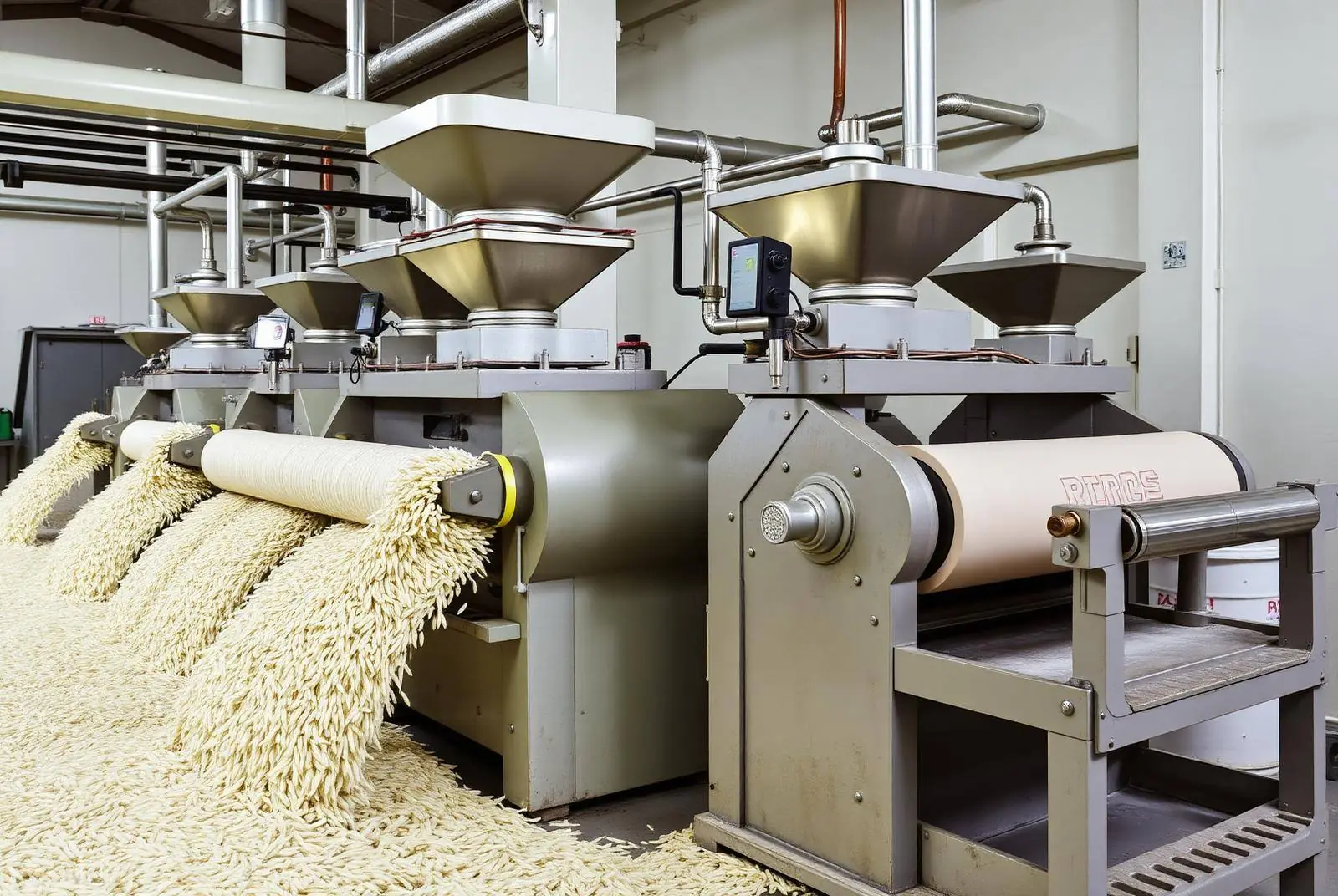
Food machinery · 02
Head rice yield is the only number that matters.
Every rice mill can turn paddy into rice. The difference between a plant that pays for itself and one that does not is how much of that rice leaves the mill whole. Indian rubber-roll milling technology, correctly configured for your paddy variety, routinely delivers 62–68% head rice on long-grain crops.
1 – 12 TPH paddy
Capacity range
62 – 68% typical
Head rice yield
68 – 72%
Total milled yield
Paddy intake to graded bagging
Scope
Overview
Gentle processing, staged in the right order
Broken grain is created by shock and by over-milling. A modern mill therefore removes husk with rubber rolls rather than steel, whitens in two or three light stages instead of one aggressive pass, and grades the product so that whatever does break is separated and sold as a by-product rather than dragging down the price of your head rice.
The flow begins with paddy cleaning: a vibro pre-cleaner with aspiration, a magnetic separator, and a gravity destoner. Paddy arriving above 14% moisture must be dried before milling, and we quote batch or continuous LSU dryers with husk-fired furnaces where the crop is bought wet — milling damp paddy is the single most common cause of poor head-rice yield.
Husking uses a rubber-roll sheller with two rolls at differential speed and adjustable clearance. Rubber rolls wear as a consumable and are supplied as spares in sets; hardness is selected to the paddy variety. Sheller output goes to a husk aspirator and then a paddy separator — either a compartment tray or a tray-type gravity separator — which returns unshelled paddy for a second pass and sends brown rice forward.
Whitening removes the bran layer in stages. Vertical abrasive-cone whiteners cut the bran with an emery cone; horizontal friction whiteners rub grain against grain under controlled pressure. Two or three whiteners in series, each taking a modest degree of milling, produce far less breakage than one machine driven hard. A silky polisher with a water-mist system follows, giving the glossy finish that export buyers of basmati and long-grain rice expect.
Finishing separates value. A rotary or plansifter sifter removes bran and small brokens; a length grader with indented cylinders splits head rice from large and small brokens to the percentage tolerance your contract specifies; and an optical colour sorter removes discoloured, chalky, black-speck and foreign grains at 4–10 tonnes per hour, which is what allows sale into premium retail and export markets.
At a glance
- Varieties handled
- Long grain, basmati, parboiled, short grain, glutinous
- Input moisture
- 12–14% for milling; dryers quoted above that
- Rubber roll life
- 400–800 tonnes of paddy per roll set, variety dependent
- Broken tolerance
- Graded to 5%, 10%, 25% or 100% broken as contracted
- By-products
- Husk (fuel/ash), bran (oil extraction), brokens, rice polish
- Lead time
- 40–60 days for mini mills; 90–140 days for modern plants
How we work
We source from India's established brands — we do not manufacture
Akarta Exports is a sourcing and export house. We do not own factories and we do not claim to. Our value is that we know which well-known Indian brands and manufacturers make what, to what standard, and at what price — and we buy from them to the exact specification you give us.
01 — Your specification, written down
We start from your specification, not from a catalogue. Grade, dimension, tolerance, finish, test standard, pack, artwork and labelling are put in writing and confirmed with you before a single enquiry goes out.
02 — Matched to the right Indian brand
We place that specification with established, well-known Indian brands and manufacturers in the cluster that genuinely makes the product — Morbi for tiles, Rajkot and Ludhiana for machinery, Meerut and Jalandhar for sports goods, Kerala and Gujarat for spices.
03 — Offers compared on merit
Because we own no plant and owe no factory a minimum offtake, we compare offers openly on quality, consistency, capacity and price — and tell you where a lower price will not hold up in your market.
04 — Inspected, consolidated, shipped
Our own inspectors clear the goods at the brand's plant and again before loading. Multiple brands and multiple divisions consolidate into one container, one invoice and one document set.
Brand names are disclosed to you on the offer and named on the inspection report, so you always know whose production you are buying. Where a buyer already has a preferred Indian brand, we are happy to source that brand and handle only the inspection, consolidation, documentation and shipping.
The range
Rice mill equipment we supply
Machine by machine, from paddy intake to the graded bag. Mini mills use a compact subset; modern plants use the full sequence with pneumatic conveying between stages.
- Paddy cleaning & pre-processing
- Vibro pre-cleaner with double-deck screens and aspiration, permanent magnetic drum, gravity destoner (2–15 TPH) and paddy pre-cleaner combination units, sized at 1.5× mill throughput.
- Drying & storage
- Batch dryers of 5–30 tonnes and continuous LSU dryers of 4–20 TPH with husk-fired furnace or diesel burner, plus paddy silos, bucket elevators and belt conveyors with intake pit and hopper.
- Rubber roll shellers
- Twin rubber-roll shellers of 1.5–8 TPH with differential drive, pneumatic clearance control on larger models, husk aspiration and integrated closed-circuit fan. Roll hardness matched to paddy variety.
- Paddy separators
- Compartment-tray and gravity-tray separators of 2–8 TPH that return unshelled paddy to the sheller and pass brown rice forward, with adjustable inclination and feed control.
- Whitening & polishing
- Vertical abrasive-cone whiteners and horizontal friction whiteners of 1.5–8 TPH in two- or three-stage series, followed by silky polishers with mist-water dosing for glossy export finish.
- Grading & sorting
- Rotary sifters, plansifters, indented-cylinder and rotary length graders, thickness graders, and CCD or InGaAs optical colour sorters of 2–10 TPH with 1–7 chutes for chalky and discoloured grain removal.
- Parboiling plants
- Soaking tanks, steaming vessels, pressure parboiling units and dryers for parboiled rice production, with boiler, husk-fired furnace and effluent handling quoted as part of the package.
- Bagging & by-product handling
- Net weighers and bag stitchers for 5–50 kg packs, metal detectors, husk blowers and bran conveying with cyclones for bran bagging or onward oil extraction.
Technical data
Rice mill plant specifications by capacity
Indicative envelopes for common plant sizes on long-grain raw paddy at 13% moisture. Parboiled and basmati configurations differ in whitening stages and residence time.
Swipe table to see all columns →
| Plant size | Paddy input | Whitening stages | Connected load | Footprint | Operators per shift |
|---|---|---|---|---|---|
| Mini rice mill | 1 TPH | 1 whitener | 25–35 kW | 120–180 m² | 2 |
| Mini rice mill | 2 TPH | 2 whiteners | 45–60 kW | 180–300 m² | 2–3 |
| Modern rice mill | 4 TPH | 2 whiteners + polisher | 180–220 kW | 800–1,000 m² | 4 |
| Modern rice mill | 6 TPH | 3 whiteners + polisher | 260–320 kW | 1,000–1,300 m² | 4–5 |
| Modern rice mill | 8 TPH | 3 whiteners + 2 polishers | 380–450 kW | 1,300–1,700 m² | 5–6 |
| Modern rice mill | 12 TPH | 4 whiteners + 2 polishers | 550–650 kW | 1,700–2,200 m² | 6–8 |
| Parboiling section (add-on) | 2–12 TPH | Soak, steam, dry | 60–250 kW + boiler | 400–1,200 m² | 3–5 |
Typical outturn on sound long-grain paddy: 68–72% total rice, 62–68% head rice, 8–10% bran, 20–22% husk. Yield is confirmed by trial milling on a paddy sample before the plant is contracted.
Applications & markets
Configurations by market
A mill selling into export retail is built very differently from one selling loose rice into a local wholesale market.
Export-grade rice millers
- Optical colour sorting for chalky and discoloured grain
- Silky polishing for glossy premium appearance
- Precise length grading to contracted broken percentage
- Metal detection and sortex certification for retail chains
Parboiled rice processors
- Soaking, steaming and pressure parboiling sections
- Husk-fired boiler to run the plant on its own by-product
- Heavier whitening duty for the harder parboiled kernel
- Effluent and steam condensate handling in the layout
Local & regional millers
- Compact mini mills with low connected load
- Single-shift operation with two operators
- Simple mechanical conveying instead of pneumatics
- Custom milling service for farmers on a toll basis
Cooperatives & development projects
- Paddy drying to cut post-harvest loss at village level
- Tender-specification documentation and guarantees
- Operator training and maintenance manuals in plain language
- Spares programmes for rubber rolls and emery cones
Division in numbers
12
TPH largest plant
Modern rubber-roll rice mill
68%
Peak head rice yield
Sound long-grain paddy at 13% moisture
10
TPH colour sorter capacity
Multi-chute optical sorting
40–140
Days lead time
Mini mills through modern plants
Quality assurance
Nothing leaves India until our own inspectors clear it
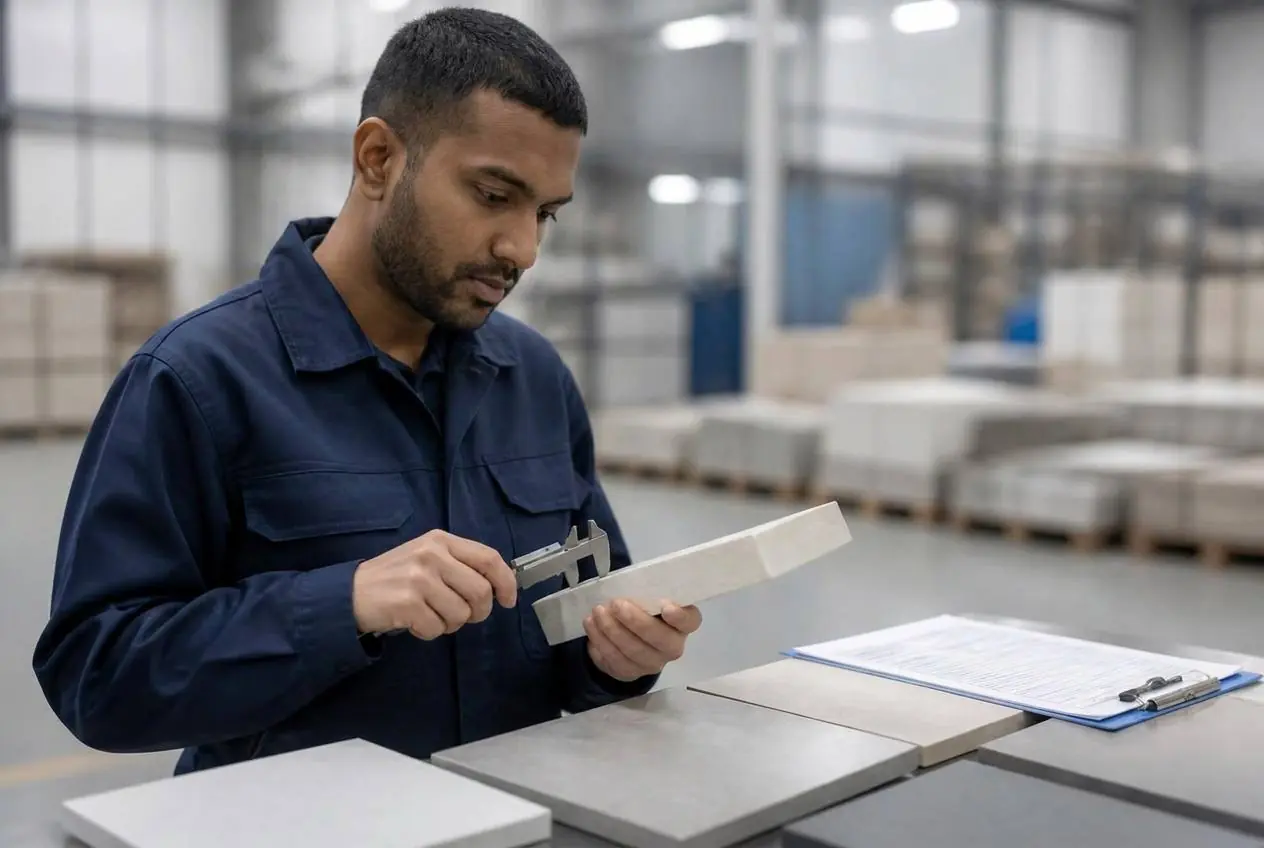
Akarta runs an in-house quality department with inspectors assigned to each division. Goods are checked at the factory during production and again before loading, against the written specification agreed on your purchase order — not against the factory's own grading.
- Pre-production sample approved by the buyer before bulk manufacture begins
- In-line checks during production for shade, calibration, dimension and moisture
- Pre-shipment inspection with photographic report before container sealing
- Third-party inspection (SGS, Bureau Veritas, Intertek) arranged where required
ISO 9001:2015
Certified quality management system
Govt. approved
Registered Indian merchant exporter
In-house docs
Export paperwork prepared by our team
Packing & shipping
Packed the way your market receives it
Rice mill machinery ships as a sequence, and the erection crew works down the flow sheet. Crates are numbered in flow order so the mill goes up in the order it runs.
- Shellers and whiteners skid-mounted in ISPM-15 crates with rolls and cones locked
- Spare rubber roll sets and emery cones packed separately and moisture-sealed
- Colour sorter crated as a sealed unit with optics protected and desiccant fitted
- Elevators and conveyors bundled by tag number with matched belts and buckets
- Crate numbering in flow-sheet order to guide erection sequence at site
- Open-top or flat-rack shipment arranged for silos, dryers and tall elevators
Documentation
Paperwork prepared in-house, not outsourced
Every consignment travels with a complete document set, prepared by our own documentation team and checked against your letter of credit or contract terms before dispatch.
Flow sheet & plant layout
Machine-by-machine paddy-to-bag flow sheet with the layout drawn to your shed dimensions and elevator heights.
Yield & trial milling report
Head rice, total rice, bran and husk outturn measured on your paddy sample before contract.
Electrical schedule & panel drawings
Motor list with kW and current, starter type, panel wiring diagram and total connected load.
O&M and consumables schedule
Rubber roll and emery cone replacement intervals, sieve and screen sizes, lubrication chart and spare part numbers.

Global reach
Quoted in your currency, shipped from your nearest Indian port
Enquiries reach us from importers, distributors, contractors and retail chains across five continents — Africa, the Middle East, Europe, the Americas and Asia-Pacific. We quote FOB, CFR or CIF, load from Mundra, Kandla, Nhava Sheva or Pipavav depending on your routing, and keep one commercial contact accountable for the consignment from purchase order to bill of lading.
Africa
Kenya, Tanzania, Uganda, Ethiopia, Nigeria, Ghana, Côte d'Ivoire, Senegal, Egypt, Morocco, Algeria, Sudan, Mozambique, Zambia, South Africa
Middle East
UAE, Saudi Arabia, Qatar, Oman, Kuwait, Bahrain, Jordan, Iraq
Europe
Netherlands, Germany, Spain, Italy, Poland, United Kingdom
Americas
United States, Canada, Mexico, Brazil, Chile
Asia-Pacific
Australia, New Zealand, Singapore, Malaysia, Vietnam, South Korea, Japan
Load ports
Mundra · Kandla · Pipavav · Nhava Sheva
Incoterms
FOB · CFR · CIF · EXW on request
Correspondence
English, with documentation to buyer-country requirements
Buyer questions
What importers usually ask us first
What head rice yield can we actually expect?
On sound long-grain paddy dried properly to 13% moisture, 62–68% head rice is realistic from a modern rubber-roll plant with staged whitening. Wet paddy, sun-cracked grain or aggressive single-stage milling will pull that down into the fifties regardless of how good the machinery is, which is why we quote dryers wherever the crop is bought wet.
Do we need a colour sorter?
If you sell packed rice into export or organised retail, yes — chalky, discoloured and black-speck grains are what buyers reject on. If you sell loose rice into a price-driven local market, a sorter may not repay its cost. It can be added later, so we design the layout with the sorter position and conveying already provided for.
Can the same plant mill both raw and parboiled rice?
Yes, with the parboiling section installed ahead of the mill and whitening duty sized for the harder parboiled kernel. Many of our buyers run raw rice in one season and parboiled in another. Tell us the intended split at enquiry so whitener staging and horsepower are chosen for both cases.
How often do rubber rolls need replacing?
Typically every 400–800 tonnes of paddy per set, depending on variety, husk abrasiveness and how tightly the rolls are set. Roll sets are the main consumable in a rice mill; every plant ships with spare sets and we keep repeat supply moving by air courier or consolidated sea shipment.
What do we do with the husk and bran?
Husk is roughly 20–22% of the paddy and is normally burned in the dryer or parboiling boiler furnace, which cuts fuel cost substantially; the ash has cement and steel-industry uses. Bran is 8–10% and is sold either as feed or to rice-bran oil extractors. Both handling systems are included in the plant scope.
Common enquiries
Specifications buyers most often ask us to quote
These are the enquiries that reach this desk most weeks. If yours is on the list, we already have the grades, packing and loadability worked out — send the quantity and destination port and we will price it.
Also in this division
Related ranges
Export desk
Request a quotation
Send your product type, grade, quantity and destination port. Our export desk replies with available grades, packing options, loadability and indicative pricing — usually within one working day.